
American Tariff of 12.5%: The Macroeconomic Cost of Slave Labor and State Subsidies in Brazil
slave labor
ECONOMIC LOSS
By Marcelo Salamon
6/3/20266 min read
Executive Summary
This article examines the macroeconomic fallout and the loss of global competitiveness facing Brazil following the 12.5% tariff proposed by the Trump administration in June 2026. The American trade retaliation exposes how humanitarian fraud and the artificial suppression of labor costs create unfair competition in international trade. It evaluates the systemic nature of this issue across Brazilian territory, ranging from transnational human trafficking in northeastern construction projects to the chronic exploitation of domestic migrants and foreign workers in southern agribusiness. The text breaks down the striking paradox of government administrations—most notably the Eduardo Leite administration in Rio Grande do Sul—shielding large corporations with massive state subsidies immediately following high-profile labor scandals, all funded by an extortionate tax burden squeezed from everyday citizens and small businesses. Finally, it denounces the deeper moral decay and regulatory collusion within the judiciary and political circles that choke out legitimate entrepreneurship, resulting in harsh global sanctions and a massive flight of human capital from the country.
Introduction
The outlook for Brazil’s exports and trade balance has just suffered its most severe financial shock. In a major macroeconomic move, the administration of President Donald Trump, through the Office of the United States Trade Representative (USTR), has formalized a proposal to slap a new 12.5% customs tariff on Brazilian products. This sweeping tariff, enforced under Section 301 of the Trade Act of 1974, follows an expedited investigation that found deep structural and systemic failures by the Brazilian state to establish effective economic barriers and impose real penalties against goods produced with forced labor.
This trade penalty comes on top of a separate 25% tariff announced just a day earlier due to broader commercial imbalances, creating an unprecedented economic bottleneck and global isolation for the Brazilian market. While direct Latin American competitors, such as Argentina, were hit with a lower additional tariff of 10%, Brazil was slapped with the maximum penalty of 12.5%. The immediate blow to supply chains and cash flows for exporting companies reflects the global price tag of a domestic liability: institutional leniency and the public funding of outsourced, sub-standard labor conditions.
The Economics of Exploitation: How the Forced Labor Machine Operates in Brazil
The American government's tariff relies on data showing how production costs in Brazil are artificially driven down through humanitarian fraud, creating an illicit competitive edge in foreign trade. Far from an isolated issue, the exploitation of labor analogous to slavery is deeply embedded in strategic sectors of the national economy, crossing both state and international borders.
Transnational Human Trafficking in Construction (Northeast)
The case of the Chinese automotive giant BYD and its manufacturing plant in Camaçari, Bahia, illustrates how massive infrastructure projects slash operational costs by violating basic human rights. Federal audits identified over 200 Chinese laborers subjected to degrading conditions, including the fraudulent immigration of hundreds of workers, severely overcrowded housing (one bathroom for 31 people), an absolute lack of mattresses, and grueling 10-hour workdays under armed guard. The lightning-fast removal of the company from the government's official "Dirty List" of slave labor via a quick court injunction—followed by the sudden firing of the National Secretary of Labor Inspection—exposed the blatant political interference that completely destroyed Brazil's macroeconomic defense in the eyes of the USTR.
Horror in the Vineyards and Local Industries (South)
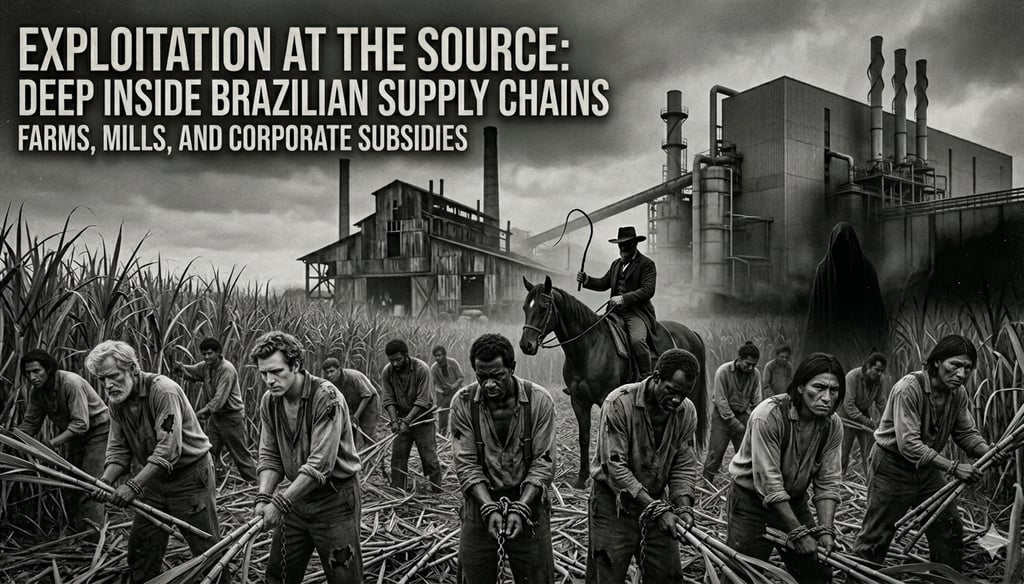
In Rio Grande do Sul governed by Eduardo Leite, a predatory economic machine combines the exploitation of domestic migrants with a vulnerable foreign workforce to lock in high profit margins for large conglomerates. In Bento Gonçalves, 207 workers—mostly Black men trafficked from the state of Bahia—were rescued while harvesting grapes for major wine industry players like Aurora, Garibaldi, and Salton. The operation was run through a shell company that constantly shifted corporate tax registry numbers (CNPJs) to evade taxes, trapping workers in a debt-slavery ring by forcing them to buy basic goods at hyper-inflated prices from a company-owned store. Laborers faced grueling 20-hour shifts, were fed rotten food, and were kept in line through physical violence, including taser shocks, pepper spray, and beatings.
The chronic nature of this suppressed-cost model was proven yet again with the subsequent rescue of Argentine and indigenous minors in São Marcos (RS), alongside recurring labor audits exposing substandard conditions in major industrial and metal-mechanic hubs like Caxias do Sul. The regional economy has become fundamentally dependent on this vulnerable workforce to preserve its market share.
The Subsidy Paradox: The Eduardo Leite Administration and Multi-Million Dollar Post-Crime Windfalls
The primary catalyst that validated trade retaliation by the Trump administration was proof that the Brazilian government, instead of enforcing crippling financial penalties to act as an economic deterrent, chose to actively bankroll the offending corporations with taxpayer money.
In Rio Grande do Sul, this predatory machine operated with the explicit backing of fiscal policies pushed by Governor Eduardo Leite. Through Fundopem (the State Enterprise Operation Fund), the Leite administration authorized a massive injection of over 70.6 million in direct tax incentives to the three major wineries involved, even after the slave labor scandals had triggered massive national and international outrage.
Beneficiary WineryVolume of Tax Incentive (Fundopem)Cash Flow ImpactAurora Winery~ 40 millionFull tax exemption amortized over 96 monthsSalton Winery~ 17–18 millionFull tax exemption amortized over 96 monthsGaribaldi Winery~ 14 millionFull tax exemption amortized over 96 months
Under the political guise of "protecting regional economic development," the Eduardo Leite administration chose to forfeit millions in state revenue in exchange for virtually nonexistent returns. Independent audits revealed that one of these corporate beneficiaries secured its multi-million dollar tax holiday while committing to create a measly 10 new formal jobs. Meanwhile, the Consent Decree (TAC) issued by prosecutors set a total fine of just 7 million split among the three brands. From a strictly accounting and cash-flow perspective, corporate crime was heavily incentivized by the state government: the financial windfall granted by the administration outpaced the cost of the labor penalty by more than ten to one.
High Taxes for the Working Class, Exemptions for the Elite, and Regulatory Backroom Deals
The fiscal model deployed in Brazil, and aggressively replicated in Rio Grande do Sul under the leadership of Eduardo Leite, has engineered a hostile and deeply lopsided business environment. The state heavily taxes basic consumption, legitimate production, and everyday citizens, maintaining one of the most suffocating tax burdens in the country (fueled by continuous attempts to hike state sales tax rates, such as the ICMS). Yet, this massive stream of public revenue is consistently drained to prop up an inefficient, bloated state apparatus managed by a political and judicial elite detached from the actual productivity of the market.
Behind the scenes of the corporate and judicial landscape, there is a long history of regulatory collusion. The proximity between massive commercial cartels, influential sectors of regular freemasonry network connections, and powerful political figures dictates the severity—or lack thereof—of legal penalties. When a major domestic corporation or multinational faces severe labor liabilities, settlements are quietly ironed out to mitigate financial damage, shielding these prominent brands from structural shutdowns or exposure on the official "Dirty List."
In stark contrast, this exact same system adopts a predatory stance against up-and-coming small and medium-sized business owners. These smaller entrepreneurs, operating on razor-thin profit margins without direct lines of political influence inside the governor’s palace, face ruthless regulatory crackdowns and crushing financial penalties that frequently bankrupt their operations. The economic ecosystem effectively punishes those trying to scale within the rules while providing bulletproof protection to the massive players operating on the fringes of human degradation.
Macroeconomic Fallout: The Human Capital Flight and Chronic Foreign Dependence
This profound economic distortion—which punishes operational efficiency with skyrocketing taxes while using state funds to subsidize corporate malpractice—has triggered a historic demographic and manufacturing collapse. Rio Grande do Sul is currently bleeding out its own population, recording the largest migration exodus in its history. Skilled laborers, young professionals, and local entrepreneurial capital are abandoning both the state and the country in droves, driven away by the fiscal strangulation of Eduardo Leite's policies and the total lack of genuine economic mobility in a rigged market.
To prevent a complete shutdown of production lines across the agro-industrial and metal-mechanic sectors, the local economy has become entirely dependent on attracting and exploiting migrant labor from economically depressed regions and foreign immigrants. However, instead of leveraging this migration influx as a high-productivity macroeconomic asset with competitive wages, the regional model relies on unchecked outsourcing as a "legal and financial human shield." The third-party middleman absorbs all the legal risks of labor exploitation, keeping the top of the corporate supply chain completely immune while the human toll and the loss of global market competitiveness are socialized.
Conclusion: Cashing the Bill for the "Brazil Cost"
The Trump administration's decision to drop a 12.5% tariff on Brazilian goods completely erodes the competitiveness of Brazilian products in the global marketplace. It proves to international markets that turning a blind eye to slave labor and handing out multi-million dollar state subsidies post-crisis—as seen under the Rio Grande do Sul administration—are not just moral failures; they are major market distortions that trigger aggressive global trade retaliation.
Brazil continues to drain its public revenue and suffocate its legitimate taxpayers to keep an obsolete corporate model afloat on political favors. The 2026 tariff shock demonstrates that local backroom deals, government protection of elite brands, and domestic legal loopholes are entirely useless in saving a country's exports when the true cost of production relies on human degradation and fiscal injustice.
References
USTR and Tariff Impact (Section 301): Economic impact and trade balance reports from the Office of the United States Trade Representative (Terra / O Tempo / Folha Vitória / Revista Oeste, June 2026).
BYD Case and Foreign Direct Investment (FDI): Forensic analysis of labor costs and supply chain impact on international corporate reputation (Repórter Brasil / Jornal Opção, 2024).
Fundopem Audit and the Eduardo Leite Administration: Technical analysis on the allocation of post-scandal state tax incentives and job creation tracking data from DIEESE (Sul 21 / Brasil de Fato / Intercept Brasil / Extra Classe, 2023-2024).
Contact
Newsletter
contact@economicfinanceworldwide.com
Fone: +55 54 991220659
© 2026. All rights reserved. https://economicfinanceworldwide.com/privacy-policy