
Bitcoin’s Cycle of Pain: Is the 2026 Bear Market Bottom Still Far Off?
Given the current volatility in digital asset markets and the increasing integration of macroeconomic policy with crypto-assets, what is your professional opinion on whether institutional investors will maintain their exposure, or should we anticipate a broader retreat to traditional safe-haven assets throughout the remainder of 2026?
Salamon and Salamon
2/24/20264 min read
Executive Summary The "four-year cycle" narrative, long the cornerstone of Bitcoin analysis, is facing its most significant challenge. As of June 2026, Bitcoin is navigating a complex transition from a halving-driven asset to a liquidity-driven barometer. Following a severe correction that saw prices plummet from 2025 highs toward the $60,000 range, the market is currently grappling with a "perfect storm": sticky inflation, geopolitical instability, and a fundamental decoupling from traditional M2 money supply growth. This report examines why the current bear market feels structurally different, how Bitcoin is reacting to global liquidity shifts, and the critical price levels that will define the next phase of the cycle.
Introduction: The End of the Traditional Cycle
The global trade landscape and monetary environment have shifted, and with them, the behavior of digital assets. For years, investors relied on the predictable four-year halving cycle to forecast Bitcoin’s price trajectory. However, the 2026 decline suggests that the "halving" is no longer the primary driver. Bitcoin is now deeply intertwined with Traditional Finance (TradFi); it moves in lockstep with global liquidity and M2 money supply, yet it has recently shown a surprising divergence. While assets like gold have rallied as a classic hedge, Bitcoin has struggled under the weight of record ETF outflows and institutional re-evaluations. We are seeing a market reset—a period of "cleansing" where excess leverage is purged and the asset’s long-term utility is tested against macroeconomic reality.The "four-year cycle" narrative is facing its ultimate test. After a turbulent start to the year, Bitcoin (BTC) continues to struggle with downward pressure, leaving investors wondering if the legendary crypto winter is settling in for a long stay. As of late February 2026, the market sentiment has shifted from cautious optimism to a search for the "ultimate floor."
The Current State of Play: No Bounce in Sight?
After failing to sustain the momentum seen in late 2025, Bitcoin has entered a consistent downtrend. Key psychological levels that once served as support have been breached, and the liquidations are stacking up. In just the last few weeks, we've seen hundreds of millions of dollars in long positions wiped out, suggesting that the market is still flushing out excess leverage.
Currently, BTC is hovering in a precarious zone. While some analysts argue this is a "mid-cycle reset," the price action suggests a classic Bear Market structure:
Lower Highs: Every attempt at a relief rally is being met with aggressive selling.
Vanishing Liquidity: On-chain data shows a significant slowdown in new capital inflows.
ETF Volatility: The institutional "safety net" provided by spot ETFs is proving to be a double-edged sword, as outflows accelerate during price drops.
Where is the Bottom? Probabilities and Targets
Pinpointing the exact "bottom" of a Bitcoin cycle is notoriously difficult, but technical indicators and historical data offer three primary scenarios for where the price might find its final base:
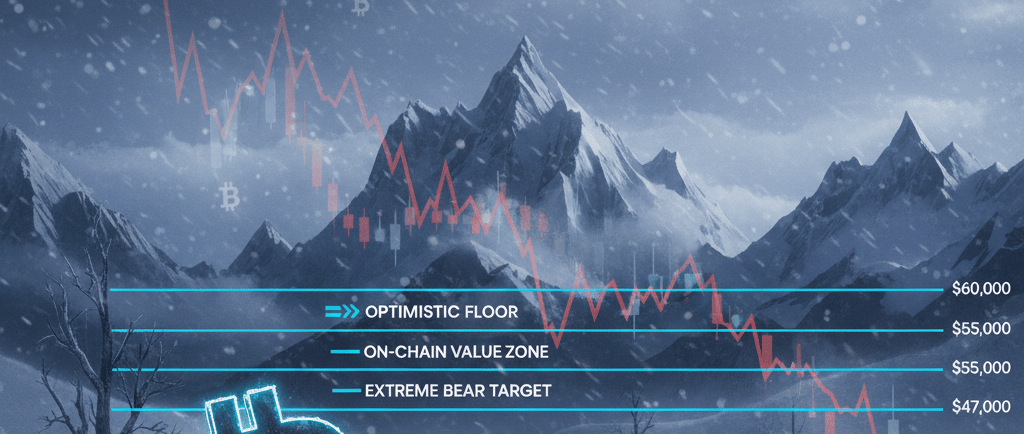
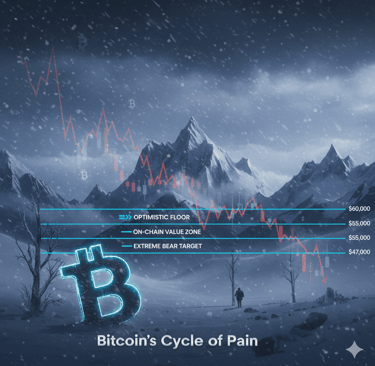
1. The $60,000 Psychological Floor
This is the "optimistic" bottom. Many institutional buy orders are clustered around the $60,000 mark. If Bitcoin can stabilize here, it would signal a structural shift where the asset no longer corrects by 80% as it did in the past. However, a break below this could trigger a "trap door" effect.
2. The $55,000 On-Chain Value Zone
According to various on-chain metrics, the realized price—the average price at which all BTC was last moved—suggests a deeper floor near $55,000. Historically, Bitcoin cycles tend to bottom out when they hit this level of "investor pain," where short-term holders finally capitulate.
3. The $47,000 "Extreme Bear" Target
If macroeconomic conditions worsen—such as persistent inflation or geopolitical shifts—some analysts eye the High-Volume Node (HVN) at $47,145. This would represent a significant retracement, aligning with the "extreme bear" phases of previous cycles where the market cleanses all remaining speculative froth. (It is worth noting that as of mid-June 2026, market sentiment remains cautious; within this group of analysts, there is a growing segment that anticipates a further correction, with projections suggesting Bitcoin could reach the $37,000 to $40,000 range by October 2026 if current liquidity outflows persist.)
Why This Cycle Feels Different
Unlike the 2018 or 2022 winters, the 2026 decline is deeply intertwined with Traditional Finance (TradFi). Bitcoin is no longer an isolated asset; it moves in lockstep with global liquidity and M2 money supply.
"We are seeing a transition from a halving-driven cycle to a liquidity-driven cycle," notes one market strategist. "The halving still matters, but the Federal Reserve's balance sheet matters more."
Patience Over Panic
While the "cycles of pain" are difficult to endure, they are a necessary part of Bitcoin's maturation. The current "Bear Market" isn't necessarily a sign of failure, but a sign of a market resetting its expectations.
For the long-term holder, the question isn't if Bitcoin will recover, but at what price the smart money will finally decide that the discount is too good to pass up. Until we see a definitive "capitulation candle" with massive volume, the path of least resistance remains downward.
Conclusion
The "cycles of pain" we are experiencing are a necessary component of Bitcoin’s maturation. The 2026 downturn is not a signal of failure, but a sign of a market resetting its expectations. As the Federal Reserve navigates sticky inflation and global geopolitical risks, Bitcoin’s role as an "inflation hedge" is being stress-tested in real-time. For the long-term holder, the path of least resistance remains downward until we see a definitive "capitulation candle" on massive volume. Until then, investors should focus on the underlying macro-liquidity trends, as Bitcoin’s recovery will likely depend more on a shift in central bank policy than on crypto-specific developments. Given the current volatility in digital asset markets and the increasing integration of macroeconomic policy with crypto-assets, what is your professional opinion on whether institutional investors will maintain their exposure, or should we anticipate a broader retreat to traditional safe-haven assets throughout the remainder of 2026?
Selected Bibliography
CF Benchmarks. The M2-Bitcoin Relationship: What the Data Actually Shows. (2026).
Intellectia.ai. Bitcoin Crash June 2026: Market Meltdown Analysis. (June 2026).
Lyn Alden. Bitcoin: A Global Liquidity Barometer. (2026).
Sarson Funds. The Correlation Between Bitcoin and M2 Money Supply Growth. (2026).
Contact
Newsletter
contact@economicfinanceworldwide.com
Fone: +55 54 991220659
© 2026. All rights reserved. https://economicfinanceworldwide.com/privacy-policy