
Economic Perspectives for Europe in 2026: A Geopolitical Resilience Assessment
Economic UE
By marcelo Salamon
5/1/20264 min read
Executive Summary
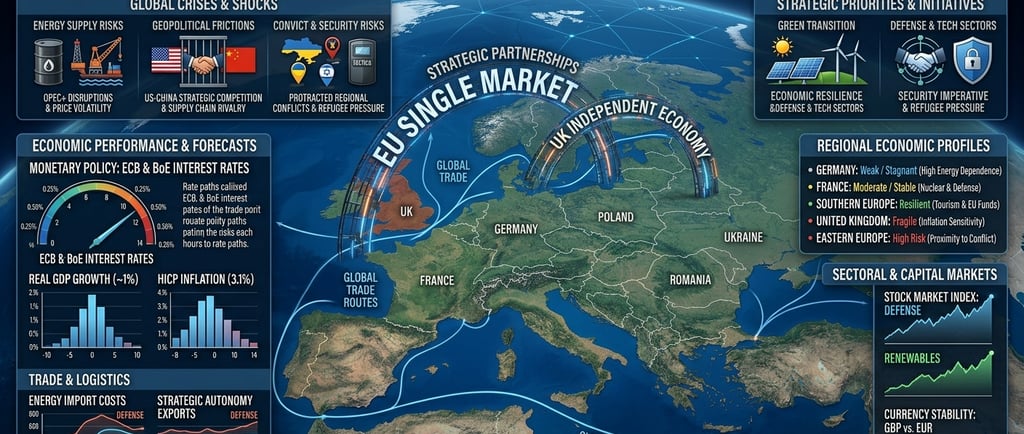
The European economic landscape in 2026 is characterized by a low-growth environment with GDP hovering around 1%. This stagnation is primarily fueled by energy-driven inflation and the systemic friction of global trade wars. Central banks, including the ECB and the Bank of England, are prioritizing monetary hawkishness to control inflation levels that have rebounded to the 3% range. While Germany's industrial sector struggles with high input costs and shifting Chinese demand, Southern European nations show relative stability through service-oriented growth. Overall, European equity markets are favoring defensive and energy-independent sectors as the continent pivots toward strategic autonomy and heightened security spending.
Introduction
As of mid-2026, the European economic landscape is defined by its attempt to navigate a "polycrisis"—a convergence of the ongoing energy shock from the Middle East, the structural shifts of the Russo-Ukrainian War, and the systemic friction between the United States and China. While 2025 showed signs of stabilization, the escalation of conflicts in early 2026 has forced a downward revision of growth forecasts. Europe currently faces a delicate balancing act: maintaining monetary discipline to curb energy-driven inflation while fostering enough industrial competitiveness to prevent a slide into a secular recession.
Macroeconomic Outlook and Monetary Policy
The Eurozone is projected to achieve a modest real GDP growth of approximately 0.9% to 1.1% for the full year of 2026. This sluggish performance is largely attributed to the "energy tax" levied by geopolitical instability.
Inflation Dynamics: After nearing the 2% target in late 2025, inflation (HICP) has spiked again, peaking at roughly 3.1% in the second quarter of 2026. This resurgence is primarily driven by supply-side shocks in the oil and gas markets.
Central Bank Response: Both the European Central Bank (ECB) and the Bank of England (BoE) have adopted a hawkish stance. The ECB has maintained its benchmark rate at 2.15%, with markets pricing in further hikes by year-end to prevent second-round effects on wages.
Stock Markets and Financial Sectors
European equities remain volatile, caught between robust corporate earnings in the tech and defense sectors and the dampening effect of high interest rates.
The Defense and Energy Pivot: Indices like the DAX (Germany) and CAC 40 (France) have seen a divergence; industrial manufacturing is struggling with high input costs, while defense contractors and renewable energy firms are seeing record investment as Europe aggressively pursues "strategic autonomy."
Banking Resilience: European banks remain well-capitalized, benefiting from higher net interest margins, though rising default risks in the SME (Small and Medium Enterprise) sector due to energy costs remain a key monitoring point.
Trade: Exports, Imports, and Global Friction
The US-China trade war has forced Europe into a difficult "de-risking" strategy.
Exports: European export growth is under pressure. Germany, the continent's industrial heart, is facing a structural loss of market share as China moves up the value chain in automotive and green tech.
Imports: Import costs remain elevated. The reliance on Liquefied Natural Gas (LNG) from the US and Qatar—though essential for decoupling from Russia—carries a significant premium compared to historical norms, impacting the trade balance of energy-intensive economies.
The Divergent Path of the United Kingdom
Outside the European Union, the UK’s perspective is distinct but equally challenged.
Economic Performance: The UK is notably more exposed to energy price shocks than its G7 counterparts. The IMF and Treasury have revised 2026 growth forecasts downward to 0.6% - 0.8%.
Brexit Realities: While services exports (finance, legal, and consulting) remain a powerhouse, goods trade intensity has permanently shifted. The UK is focused on "Global Britain" trade deals, yet these have not yet fully compensated for the increased friction in EU-UK supply chains.
Currency (GBP vs. EUR): The Pound Sterling has shown resilience against the Euro, trading at approximately €1.16 ($0.86 GBP per Euro). Investors favor the BoE’s aggressive inflation-fighting stance over the ECB’s more cautious approach.
Regional Impact and National Variations
The economic outlook across the continent varies significantly based on energy mix and trade exposure. Germany faces a weak and nearly stagnant outlook due to its high historical energy dependence and declining automotive exports to China. Conversely, France maintains a more moderate and stable position, bolstered by its nuclear energy mix and strong exports in luxury goods and defense. In Southern Europe, economies remain surprisingly resilient, supported by robust tourism and the efficient deployment of EU Recovery Funds. However, the United Kingdom remains fragile due to high inflation sensitivity and ongoing structural adjustments post-Brexit. Finally, Eastern Europe occupies a high-risk category, driven by direct geographic proximity to the Ukraine conflict and the resulting necessity for massive defense spending.
Conclusion
By the end of 2026, the European Union is expected to emerge not through a return to the "old normal," but through a painful transition toward a more securitized economy. The "green transition" is no longer just a climate goal but a core security imperative. While the threat of a deep recession remains if Middle Eastern tensions escalate further, the base case is one of "muddling through"—low growth, persistent but manageable inflation, and a significant realignment of trade toward trusted geopolitical allies.
Selected Bibliography
European Central Bank. Eurosystem Staff Macroeconomic Projections for the Euro Area. (June 2026).
European Commission. Spring 2026 Economic Forecast: Slowdown in Growth as Energy Shock Drives Inflation. (2026).
OECD. European Union and Euro Area Economic Snapshot. (June 2026).
Deutsche Bank Research. European Macro Outlook: The Impact of the Energy Shock. (2026).
Financial Times. ECB Raises Interest Rates for the First Time Since 2023. (June 2026).
Trading Economics
Contact
Newsletter
contact@economicfinanceworldwide.com
Fone: +55 54 991220659
© 2026. All rights reserved. https://economicfinanceworldwide.com/privacy-policy