
Geopolitics vs. Portfolios: Assessing the Systemic Risk of Failed Diplomacy in a $110-Oil Environment
Today´s news
Salamon, Marcelo
4/10/20264 min read
Executive Summary
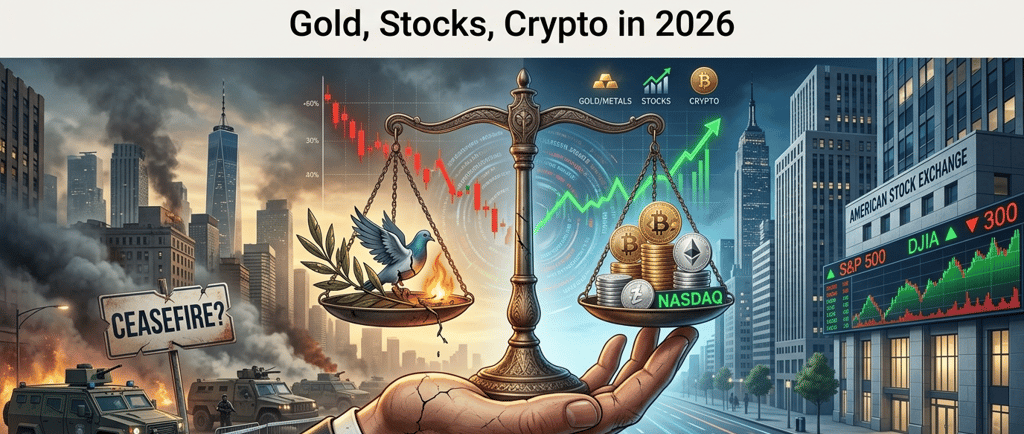
The global financial markets are currently locked in a precarious state of volatility, driven by the uncertainty surrounding diplomatic truces and the genuine risk of "false ceasefires." This report evaluates the behavior of major asset classes—specifically gold, equities, and cryptocurrencies—as they navigate the thin line between a structural de-escalation and tactical pauses in geopolitical conflict. While the market often prices in peace prematurely, the discrepancy between diplomatic optics and underlying commodity prices, particularly in the energy sector, suggests that investors must maintain a defensive, liquidity-focused stance. By distinguishing between genuine diplomatic progress and market-trap volatility, investors can better position themselves to mitigate the risks of a potential year-end downturn while remaining prepared for a stable, fundamental-driven recovery in late 2026.
Introduction
The global markets are currently caught in a high-stakes tug-of-war between diplomatic hope and geopolitical skepticism. As headlines flicker with news of potential truces, investors are forced to distinguish between a genuine ceasefire—one that leads to structural de-escalation—and a false ceasefire, which is often used as a tactical pause for regrouping.
Understanding this distinction is critical for anyone managing a portfolio in the current climate. The difference between real peace and a strategic ruse determines whether the current market movement is a sustainable rally or a dangerous bull trap.
The Safe Haven Swing: Gold and Precious Metals
Gold remains the ultimate barometer of global anxiety. When a ceasefire is announced, we typically see a knee-jerk "risk-on" move where gold prices dip as institutional money flows back into equities. However, in the event of a false ceasefire, gold’s retreat is usually short-lived. Once the "tactical pause" is exposed, the rebound is often more aggressive, driven by a total loss of trust in diplomatic channels.
For the next few months, expect gold to trade in a highly volatile range. Despite these swings, the long-term outlook through the end of 2026 remains bullish. With central banks continuing to diversify reserves away from traditional fiat currencies, the floor for precious metals stays high. Silver and platinum will likely follow this trend, though they will remain more sensitive to industrial demand.
Wall Street’s Reaction: The Equity Rollercoaster
The U.S. stock market hates uncertainty more than it hates bad news. A credible ceasefire provides a "clear runway" for growth, particularly in the tech and manufacturing sectors, as supply chain fears ease. In the coming weeks, expect "headline trading," where positive rumors spike the S&P 500 while any breach of a truce triggers sharp sell-offs.
By the end of the year, if a true de-escalation takes hold, the focus will shift back to domestic fundamentals, specifically interest rates and corporate earnings. We could see moderate growth if inflation continues to cool. However, if the conflict remains stuck in a loop of failed truces, the market will likely trade sideways with a bearish tilt as investors grow weary of the instability.
Digital Gold: The Crypto Factor and the Year-End Forecast
Bitcoin and the broader cryptocurrency market have increasingly behaved like a hybrid asset—part tech stock, part geopolitical hedge. Because crypto markets trade 24/7, they are often the first to react to shifts in diplomacy. We are currently seeing a "flight to digital quality." During periods of failed diplomacy, Bitcoin often sees increased adoption in regions with collapsing local currencies or restricted banking.
In the short term, Bitcoin is expected to remain range-bound, reacting sharply to every news cycle. However, looking toward the end of 2026, the outlook is geared toward growth. As institutional adoption increases and crypto becomes more integrated into standard portfolios, it may finally begin to decouple from the Nasdaq, though price swings will remain much wider than traditional assets.
The Bottom Line for Investors
The market is currently pricing in the possibility of peace, but it hasn't fully bought into it yet. The biggest risk for the remainder of the year is the "false ceasefire," which lures buyers in during a temporary price rise only to leave them exposed when conflict resumes.
The most successful investors for the rest of 2026 will be those who prioritize liquidity and watch the commodities market closely. If energy prices remain stubbornly high despite ceasefire talk, the market is signaling that it does not believe the peace will last. Keeping a balanced eye on the difference between a handshake for the cameras and a signed treaty will be the key to surviving this volatility.
Conclusion
In the current geopolitical environment, the distinction between a genuine ceasefire and a strategic ruse is the most important variable for portfolio preservation. Markets are prone to "bull traps" triggered by premature optimism, yet the underlying reality of high energy prices and central bank reserve diversification suggests that volatility will remain the baseline for the remainder of 2026. The most successful strategies will move beyond headline-driven reactions, instead focusing on commodity signals and liquidity management as the ultimate truth-tellers. Investors should view this period not as a time for aggressive expansion, but as a window to consolidate positions in assets—such as precious metals and strategically chosen digital assets—that offer a hedge against the inevitable failure of diplomatic theater. By maintaining a disciplined, skeptical approach to news cycles, investors can navigate the instability of 2026 and remain positioned for the eventual return of fundamental, value-driven market growth.
Selected Bibliography
Council on Foreign Relations. Diplomatic Stability and Market Volatility: A 2026 Geopolitical Risk Assessment. (June 2026).
Goldman Sachs Research. Asset Allocation in the Era of Geopolitical Headwinds. (May 2026).
J.P. Morgan Asset Management. The Safe-Haven Dilemma: Gold, Bitcoin, and the Future of Defensive Portfolios. (June 2026).
Bloomberg Intelligence. Commodity Price Signals as Predictors of Geopolitical De-escalation. (April 2026).
CFA Institute. Behavioral Finance and Market Reactions to Geopolitical News Cycles. (2026).
Contact
Newsletter
contact@economicfinanceworldwide.com
Fone: +55 54 991220659
© 2026. All rights reserved. https://economicfinanceworldwide.com/privacy-policy