
Global Economic Report: Market Surges and Geopolitical Friction
Financial Analysis
By Marcelo Salamon
5/7/20264 min read
Executive Summary
The global economic landscape in June 2026 is defined by stark contradictions. While equity markets initially showed resilience, they are currently facing significant pressure from AI-sector profit-taking and intensifying geopolitical instability. The U.S. Dollar remains under structural downward pressure, reflecting a broader shift in global capital allocation, while the conflict in the Middle East has entered a phase of "routinized brinkmanship," where the management of instability has become the new regional norm.
Introduction
The global economic landscape in June 2026 presents a series of profound and deepening contradictions. We are currently navigating a reality defined less by historical precedent than by the collision of disparate, high-stakes forces. While public equity markets—buoyed by persistent, albeit selective, AI-driven optimism—continue to reach for unprecedented heights, the foundations of this "euphoria" are increasingly questioned by a fragile macroeconomic reality. Beneath the surface of rising indices, the global order is being fundamentally reoriented by a "polycrisis": the convergence of intensifying geopolitical conflict in the Middle East, the structural friction of trade fragmentation, and an energy shock that has recalibrated the cost of production worldwide.
This is a market environment where institutional confidence and systemic risk coexist in a precarious balance. Central banks are caught in a hawkish pivot, forced to manage resurging inflation while the private sector grapples with the limitations of a global supply chain increasingly fractured by security imperatives. As geopolitical instability overtakes traditional trade concerns as the primary threat to growth, the "soft landing" narrative is being stress-tested by a reality of higher-for-longer interest rates and the weaponization of capital flows. For the modern allocator, understanding this era requires looking past the superficial resilience of headline numbers to identify the genuine structural shifts occurring in currency, commodity, and security markets. We are no longer operating in a linear recovery; we are in a period of structural realignment where the old pillars of stability—cheap energy, predictable trade, and monetary ease—have been replaced by a friction-heavy, high-stakes environment that demands a new level of analytical rigor.
The Equity Rally and S&P 500 Dominance
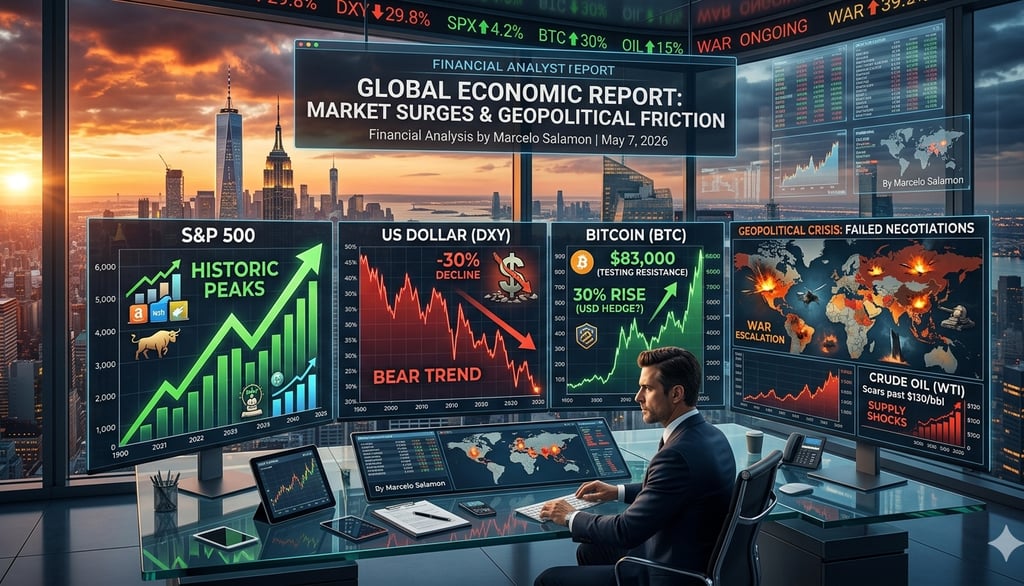
The S&P 500 continues to defy gravity. Despite many analysts warning of overvaluation, the index shows no signs of slowing down. This relentless climb is deeply tied to tech-sector liquidity and investor confidence in a soft landing. Investors are currently favoring high-risk assets, seemingly pricing out macroeconomic warning signs in favor of momentum.
The US Dollar Slide and Currency Fractions
In stark contrast to the equity markets, the US Dollar has suffered a significant downturn. During this period, the dollar index has plummeted, redefining global trade balances. With a drop approaching 30% against certain currency baskets, the devaluation is having a direct impact on import pricing and international debt management. We are seeing specific downward fractions in the DXY that indicate a fundamental shift in capital allocation away from the greenback.
Geopolitical Crisis: Failed Negotiations
As of today, reports indicate that the warring parties have failed to reach an agreement. The absence of a deal carries heavy consequences. Beyond the inevitable spike in crude oil prices, we must anticipate further ruptures in global supply chains and a drastic increase in logistics costs. This uncertainty fuels inflationary expectations even as markets appear temporarily immune to the news.
Bitcoin: Safe Haven or S&P 500 Shadow?
Bitcoin has reached a crossroads at the $83,000 level. A critical question remains: has it truly decoupled from traditional markets? Current data suggests that Bitcoin still maintains a strong correlation with the S&P 500, moving in tandem but with amplified volatility.
From a technical standpoint, a natural market correction is expected after testing the $83,000 resistance. This is a healthy part of the cycle. However, it is noteworthy that while the dollar collapsed during this period, Bitcoin rose by nearly 30%, strengthening its narrative as an alternative store of value. Whether it can maintain its status as a "Safe Haven" asset amidst escalating war remains the ultimate test for the upcoming quarter.
Market Summary:
S&P 500: Bullish momentum continues despite overhead risks.
Bitcoin (BTC): Testing $83,000; technical correction likely.
US Dollar: Bearish trend persists with a 30% decline.
Crude Oil: Upward pressure expected due to failed peace talks.
Conclusion
As we look toward the second half of 2026, the convergence of "managed" geopolitical conflicts and macroeconomic uncertainty suggests a period of persistent volatility. The assumption that equity markets can indefinitely decouple from these fundamental risks is being challenged by rising inflation prints and the realization that the "soft landing" narrative is increasingly fragile. Investors should prepare for a regime shift where institutional-grade safety is no longer guaranteed by traditional assets alone. The ability to navigate this environment will depend on recognizing that we are not witnessing a temporary crisis, but a structural realignment of global finance—where the era of cheap liquidity and stable energy costs has been replaced by a more complex, friction-heavy reality. True sovereignty for capital, therefore, lies in understanding that market resilience is as much a function of geopolitical adaptation as it is of economic performance.
Selected Bibliography
Brookings Institution. How the Iran War will change the Middle East. (June 10, 2026).
Galaxy Digital Research. Bitcoin Four-Year Cycle: Where is the Bottom? (June 9, 2026).
Kavout. Is the US Dollar’s Dominance Truly Fading in 2026? (2026).
Manara Magazine. The Middle East Is Not Stabilizing—It Is Learning to Manage Instability. (June 9, 2026).
Saxo Bank. Options Brief: The fear gauge already knows. (June 10, 2026).
Contact
Newsletter
contact@economicfinanceworldwide.com
Fone: +55 54 991220659
© 2026. All rights reserved. https://economicfinanceworldwide.com/privacy-policy