
Global Markets on Edge: The 2026 Middle East Crisis and Your Portfolio
Between $130 Oil and Bitcoin's 'Digital Gold' Test: How the 2026 Middle East Crisis is Redefining Global Wealth, Market Winners, and the Future of Crypto.
3/10/20264 min read
Executive Summary
The geopolitical landscape of 2026 has reached a critical juncture, with Middle Eastern tensions acting as the primary catalyst for global market volatility. This report evaluates the three most probable trajectories for the global economy: the "Long War" of persistent attrition, the "Flashpoint" of major escalation, and the "Peace Dividend" of diplomatic resolution. As investors navigate this environment, the traditional lines between energy policy, sovereign debt, and digital asset performance are blurring. With Brent crude acting as a global tax and Bitcoin increasingly tested as a store of value, this analysis breaks down the sectoral winners and losers, providing a framework for diversification in an era where markets trade geopolitics as frequently as they trade balance sheets.
Introduction
The geopolitical landscape of 2026 has reached a critical juncture. As tensions in the Middle East dominate the headlines, investors worldwide are asking the same question: How will the financial markets, global exchanges, and the crypto ecosystem react to the next move?
Whether the conflict extends, escalates, or finds a path to peace, the ripple effects will be felt from Wall Street to the digital wallets of crypto traders. Here is the breakdown of the three most likely scenarios and who stands to win or lose.
Scenario 1: The "Long War" (Extended Conflict)
In this scenario, the conflict remains localized but persistent. We see a "war of attrition" that keeps the global economy in a state of high anxiety.
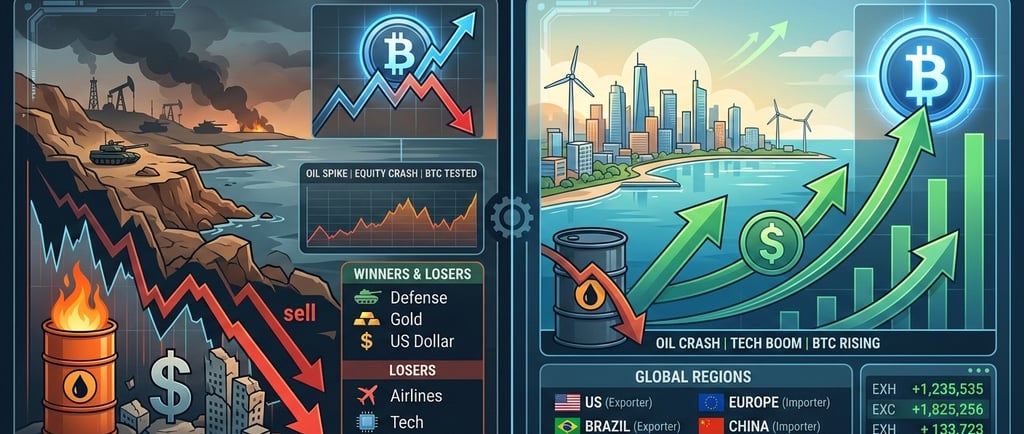
Stock Markets: Expect a "sideways" market. Major indices like the S&P 500 will face "headline risk," where a single breaking news alert can cause a $50 to $100 swing in price action within minutes. Defensive sectors—Defense, Healthcare, and Utilities—will become the primary refuge.
Crypto & Bitcoin: Bitcoin likely remains range-bound. While it has matured as an institutional asset, it still behaves like a "risk-on" asset in times of moderate stress, meaning it won't see a massive breakout until the uncertainty clears.
Commodities: Oil prices will likely hover between $85 and $95, keeping global inflation "sticky" and preventing central banks from lowering interest rates.
Scenario 2: The "Flashpoint" (Major Escalation)
If the conflict expands to include key transit points like the Strait of Hormuz, we enter a "Black Swan" event.
Stock Markets: A sharp, aggressive sell-off. Tech stocks and consumer discretionary brands will be hit hardest as energy costs skyrocket. The U.S. Dollar will surge as the world’s "Safe Haven," potentially crushing weaker foreign currencies.
Crypto: This is the ultimate test for the "Digital Gold" theory. Initially, crypto may crash alongside stocks as traders rush for liquidity. However, if fiat currencies devalue due to hyper-inflation, Bitcoin could see a decoupled surge as a decentralized store of value.
The Energy Spike: Crude oil could realistically breach the $120 to $150 mark, triggering a global recessionary warning.
Scenario 3: The "Peace Dividend" (Conflict Ends)
A sudden diplomatic breakthrough or ceasefire would trigger one of the largest "Relief Rallies" of the decade.
Stock Markets: A massive V-shaped recovery. Growth stocks, AI-driven tech, and international markets would lead the charge.
Crypto: Digital assets would likely skyrocket. With the "fear premium" removed and the prospect of lower interest rates returning, liquidity would flow back into the crypto ecosystem, potentially pushing BTC toward new all-time highs.
Commodities: Oil would likely plummet back to the $65 to $75 range, acting as an immediate stimulus for the global transport and manufacturing sectors.
The Winners and The Losers
Sector The Winners The Losers
Traditional Finance erospace & Defense, Big Oil, Gold, Airlines, Cruise Lines, and the U.S. Dollar. Automotive, and Retail
Global RegionsUnited States (Energy Independent) and Europe and East Asia Brazil/Norway (Exporters). (High dependency on imported energy)
Digital AssetsBitcoin BTC) and Stablecoins (USDT/USDC) Highly speculative Altcoins and "Meme" coins
The Bottom Line
In 2026, the market isn't just trading balance sheets; it's trading geopolitics. For the average investor, diversification is no longer a suggestion—it is a survival tactic. Whether you are holding stocks or Satoshi, volatility is the only guarantee.
Are you hedging with Gold and Defense stocks, or are you betting on a "Relief Rally" in Tech and Bitcoin? Let us know your strategy in the comments below, and don’t forget to subscribe to our 2026 Market Watch newsletter.
Conclusion
As we evaluate the remainder of 2026, it is clear that the market is no longer driven by balance sheets alone; it is dictated by the velocity of geopolitical events. The "resilience paradox" we observe is built on the assumption that global supply chains are sufficiently modular to absorb shocks, but this remains a high-stakes gamble. For the modern investor, diversification has transitioned from a passive suggestion to a survival imperative. Whether the current tension leads to a protracted "Long War" or a sudden "Peace Dividend," the underlying reality remains that volatility is the only constant. Strategy in this climate requires a bifurcated approach: hedging with tangible defensive assets like energy and gold, while maintaining exposure to high-growth tech and Bitcoin to capture the potential upside of an eventual relief rally. The winners of 2026 will not be those who predict the next headline, but those who build portfolios capable of thriving in a state of permanent flux.
Selected Bibliography
Council on Foreign Relations. Global Conflict and the Energy Transition: 2026 Outlook. (May 2026).
Goldman Sachs Global Investment Research. Geopolitical Risk Premiums in Equity Valuations. (June 2026).
International Energy Agency (IEA). Strait of Hormuz and Global Supply Chain Vulnerability: A 2026 Risk Assessment. (April 2026).
CoinDesk Research. Digital Assets in Geopolitical Crises: The Decoupling Narrative. (May 2026).
J.P. Morgan Asset Management. Navigating the 2026 Volatility Cycle: Defense, Energy, and Tech. (2026).
Contact
Newsletter
contact@economicfinanceworldwide.com
Fone: +55 54 991220659
© 2026. All rights reserved. https://economicfinanceworldwide.com/privacy-policy