
The Architect of the Soft Landing: A Six-Year Retrospective on Jerome Powell’s Fed
History
BIOGRAPHIC
By Marcelo Salamon
4/30/20264 min read
Executive Summary
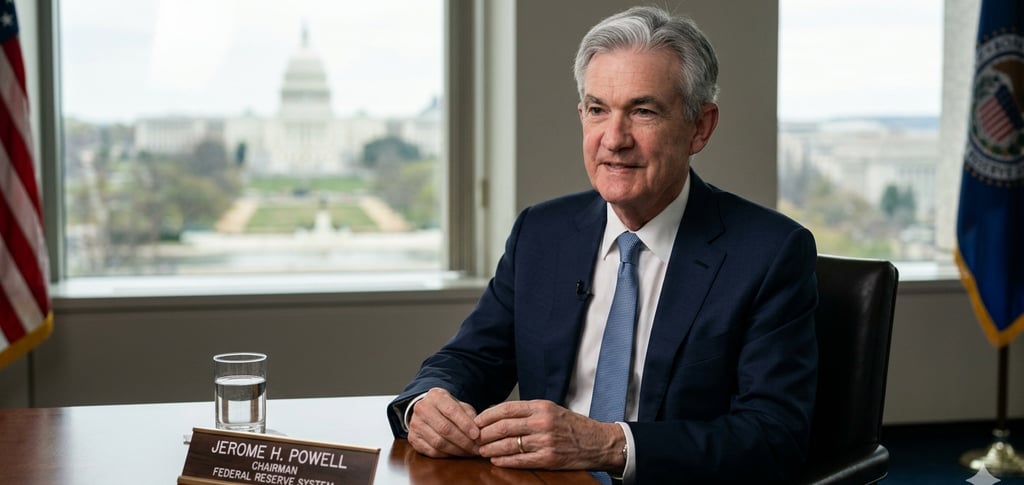
This report analyzes the leadership of Jerome Powell, contrasting his pragmatic, non-academic background in law and high-stakes finance with the traditional economist profiles of his predecessors. Powell’s tenure was marked by the massive, unprecedented monetary expansion of 2020, which successfully averted a global financial collapse, followed by a aggressive cycle of interest rate hikes to combat 40-year inflationary highs. While he is credited with orchestrating a potential "soft landing," his legacy is also complicated by the "transitory" inflation miscalculation and the 2023 banking instability. Ultimately, Powell’s leadership has been defined by a constant battle to maintain the Federal Reserve’s institutional independence amidst unprecedented political scrutiny, culminating in his departure as Chair in May 2026.
Introduction
Jerome Hayden Powell, the 16th Chair of the Federal Reserve, stands as one of the most consequential figures in modern American economic history. Steering the world’s most powerful central bank through a global pandemic, a generational spike in inflation, and intense political crosswinds, his tenure has been defined by bold "red-line" crossings and a fierce defense of institutional independence.
The Foundation: Academic and Professional Profile
Born on February 4, 1953, in Washington, D.C., Jerome Powell was raised in Chevy Chase, Maryland. Unlike many of his predecessors who held doctorates in economics, Powell’s background is rooted in law and high-stakes finance, giving him a "pragmatic" rather than purely "academic" reputation.
Education: Powell attended the prestigious Georgetown Preparatory School before moving to Princeton University, where he earned a Bachelor of Arts in politics in 1975. He then returned to D.C. to attend Georgetown University Law Center, serving as the editor-in-chief of the Georgetown Law Journal and graduating with a Juris Doctor in 1979.
Early Career: Before his time at the Fed, Powell was a partner at the Carlyle Group (1997–2005) and held senior positions at the investment bank Dillon, Read & Co. He also served in the Treasury Department under President George H.W. Bush as Assistant Secretary and Undersecretary for Domestic Finance.
Direction and Profile: Powell is often described as a "Centrist" and a "Pragmatist." He is known for building consensus among the Board of Governors and for his "plain-English" communication style during FOMC press conferences, a deliberate shift away from the "Fedspeak" of previous eras.
Eight Years at the Helm: The Good and the Bad
Powell was first nominated as Chair by Donald Trump in 2018 and later reappointed by Joe Biden in 2022. His six-plus years in the lead have been a rollercoaster of historic highs and lows.
The Successes ("The Good")
Pandemic Response (2020): Powell is widely credited with preventing a total global financial collapse during the COVID-19 lockdowns. He slashed interest rates to near zero and launched unprecedented lending programs, famously stating that the Fed "crossed a lot of red lines" to support the economy.
Soft Landing Hopes: Despite fears of a massive recession, Powell’s aggressive rate hikes starting in 2022 managed to bring inflation down from a 40-year high of 9.1% to much lower levels while keeping the labor market remarkably resilient.
The Failures ("The Bad")
The "Transitory" Error: Perhaps the biggest stain on his record was the Fed’s insistence throughout 2021 that inflation was "transitory." This delay in raising rates is blamed by many for allowing prices to spiral out of control.
Banking Instability: Critics argue that the rapid pace of his interest rate hikes contributed to the collapse of Silicon Valley Bank and others in 2023, as the sudden shift devalued the bond portfolios held by regional banks.
The View from the Trenches: Analysts and Politicians
The discourse surrounding Powell is deeply polarized.
Economic Analysts: Some, like those at the Heritage Foundation, have labeled him one of the most "problematic" chairs for fueling government spending through "money printing." Conversely, many mainstream economists praise him for his bravery during the 2020 crisis and his ability to ignore political noise to maintain the 2% inflation target.
Politicians: His relationship with Donald Trump was famously fractured. Despite appointing him, Trump frequently attacked Powell on social media, calling him "too slow" and "clueless" for not cutting rates. Recently, in 2026, the relationship remained tense as Trump’s DOJ launched investigations into Fed building renovations—a move Powell and his allies decried as political intimidation.
Other Influencers: Figures like Senator Elizabeth Warren famously opposed his second term, calling him a "dangerous man" due to his perceived stance on bank deregulation. Meanwhile, Joe Biden and Treasury Secretary Janet Yellen have generally provided him with the institutional cover needed to operate.
Powell’s Self-Assessment and Future
As his term as Chair concludes in May 2026, Powell has remained steadfast. In recent press conferences, he has expressed a mix of concern and pride. He has admitted that "with the benefit of hindsight," the Fed might have moved earlier on inflation, but he maintains that the emergency actions of 2020 saved millions of jobs.
Powell has recently emphasized the "battering" the Fed has taken from political attacks, warning that "Fed independence is at risk." Even as he prepares to step down as Chair, he has announced he will remain on the Board of Governors for a period to oversee the transition, signaling that his influence on the American economy is not quite over yet.
Conclusion
As Jerome Powell concludes his term as Chair of the Federal Reserve, his legacy remains deeply polarized yet undeniably central to the American economic narrative. He successfully balanced the "dual mandate" by navigating the extremes of a global pandemic and the subsequent inflationary recovery. However, his tenure serves as a stark reminder of the limits of monetary policy, particularly regarding the delayed recognition of systemic inflation and the volatility inherent in rapid interest rate adjustments. Powell’s final warnings regarding the fragility of "Fed independence" underscore the challenges that his successor will face in an era where central banking is increasingly entangled with populist politics. His decision to remain on the Board of Governors signals a commitment to institutional continuity, yet the American economy he leaves behind is one characterized by the need for renewed fiscal discipline and the ongoing defense of technocratic autonomy.
Selected Bibliography
Board of Governors of the Federal Reserve System. The Powell Years: A Retrospective on Monetary Policy and Crisis Management (2018–2026).
Council on Foreign Relations. Central Bank Independence in the Age of Political Polarization. (May 2026).
The Wall Street Journal. The Architect of the Soft Landing: Analyzing Jerome Powell’s Legacy. (June 2026).
Brookings Institution. Inflation, Interest Rates, and the Fed: Lessons from the 2020–2026 Cycle. (2026).
U.S. Congress – Joint Economic Committee. Hearing on the Performance and Regulatory Oversight of the Federal Reserve. (2026).
Contact
Newsletter
contact@economicfinanceworldwide.com
Fone: +55 54 991220659
© 2026. All rights reserved. https://economicfinanceworldwide.com/privacy-policy