
Revolutionizing Investing: How AI Can Boost Your Portfolio
AI is a powerful tool that can revolutionize investing by analyzing data, automating trades, managing risks, and providing personalized advice, but it should be used in conjunction with human judgment and a comprehensive understanding of the market.
Salamon and Salamon
3/8/20263 min read

Executive Summary
As of June 2026, Artificial Intelligence has transitioned from a theoretical investment thesis to the fundamental operating system of global finance. This report explores how AI is reshaping investment strategies by enabling real-time data synthesis, hyper-personalized financial advisory, and automated risk management. With hyperscaler capital expenditure projected to reach $690 billion in 2026, AI is no longer just a tool—it is the defining variable in how value is created, monitored, and captured. We examine the democratization of institutional-grade intelligence and emphasize that while AI offers a competitive edge, successful wealth building requires a balanced "human-in-the-loop" approach to navigate the complexities of modern market dispersion.
Introduction
The investment landscape has undergone a radical shift. In prior years, markets rewarded companies for merely mentioning "AI" in their earnings calls. Today, the "AI moment" has matured; investors now demand tangible evidence of monetization, margin expansion, and cost-efficiency. AI has become a transformative force, enabling investors to process multimodal datasets—including financial filings, social sentiment, satellite imagery, and supply chain logistics—with speed and accuracy that far exceed human capability. This evolution is effectively democratizing access to sophisticated strategies, turning the act of investing into a data-driven science of precision.
The Mechanisms of AI-Powered Investing
Modern AI-driven investment management relies on three core pillars that have redefined how capital is deployed:
Data Analysis at Scale: Today’s AI platforms can process infinitely long sequences of market data using State Space Models (SSM) and transformer architectures. Unlike legacy systems that struggled with quadratic computational complexity, 2026-era models analyze tick-by-tick order book microstructure in real-time, identifying nonlinear correlations that are invisible to traditional quantitative models.
Agentic Intelligence: The industry is moving toward "agentic AI"—autonomous systems capable of planning, executing, and monitoring trades within predefined constraint-aware environments. These AI "copilots" act as research assistants, widening the funnel of potential ideas and allowing human researchers to focus on high-level strategic evaluation rather than manual document parsing.
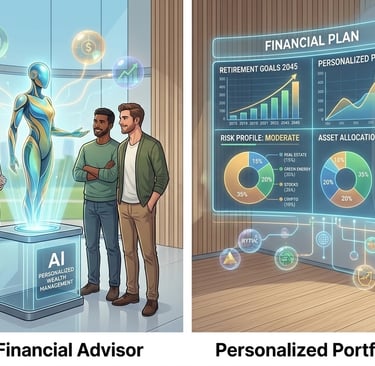
Democratization of Advice: Robo-advisory platforms have evolved into hyper-personalized banking partners. By analyzing spending patterns, life events, and risk tolerance in real-time, generative AI now offers tailored investment options that adapt to market volatility before the investor even initiates a query.
The New Rules: Essential Strategies for 2026
While AI provides unprecedented power, it is not a "magic bullet" that replaces the need for discipline. Effective use of these tools in 2026 requires a rigorous framework:
Prioritize Explainability: As AI takes on more complex roles, from underwriting to trade execution, "black box" models are being phased out in favor of systems that provide decision traceability. Always verify why a model recommends a specific asset allocation.
Human Oversight (The "Kill-Switch"): Market history is replete with examples of automated flash crashes. Using AI as a "kill-switch" feed—where human supervisors intervene if high-impact signals trigger anomalous volatility—is now considered a mandatory best practice for family offices and individual investors alike.
Cross-Check Against Fundamentals: AI can find spurious relationships that are merely statistical aberrations. Sound investment principles, such as diversification across uncorrelated asset classes, remain the ultimate safeguard against algorithmic bias.
Integration Over Raw Power: The winners in 2026 are not those with the most compute power, but those who best integrate AI into their operational workflows. "Company-aware" AI systems that understand your specific risk profile and financial goals outperform generic market-scanning bots every time.
Navigating the Risk: When Machines Collide
A significant risk in 2026 is "herd behavior." If too many market participants rely on the same AI models or the same data inputs, the resulting trades can lead to systemic liquidity collapses. Investors must maintain research discipline, ensuring their portfolio is anchored in diversified income and fundamentals that exist independently of algorithmic trends. As AI continues to target cognitive labor—a sector previously immune to automation—the ability to redeploy human judgment into higher-value roles will be the ultimate differentiator between stagnant portfolios and wealth growth.
Conclusion: The Human-Machine Feedback Loop
The future of investing is not about AI replacing humans; it is about humans who use AI effectively replacing those who do not. We are in a "two-speed economy" where companies and investors that translate AI into durable cost advantages and cash-flow resilience separate themselves from those that cannot. As we progress through the remainder of 2026, the key to financial success will be maintaining a constructive human-machine feedback loop: using the machine to handle the data-heavy lifting while retaining the human capacity for long-term vision, ethical judgment, and strategic risk assessment.
Note: This report is current as of June 14, 2026.
Selected Bibliography
BlackRock. Investing in 2026: AI, War, and Income. (June 2026).
Morgan Stanley Research. AI Market Trends: Global Investment, Risks, and Buildout. (2026).
Two Sigma. AI in Investment Management: 2026 Outlook. (January 2026).
Cognizant. 2026: The Year AI Gets Real in Financial Services. (2026).
Amundi Research Center. AI Investment Research: 2025-2026 Trends. (2026).
Contact
Newsletter
contact@economicfinanceworldwide.com
Fone: +55 54 991220659
© 2026. All rights reserved. https://economicfinanceworldwide.com/privacy-policy