Strategic Wealth Engineering: A 20-Year Blueprint for Adolescent Capital Accumulation
Save
By Marcelo Salamon
4/30/20265 min read
Titan Case Studies: The Architecture of Influence
To master the market, one must study the architects of modern capital who dictate sentiment and structure:
Warren Buffett (The Compounder): Teaches the importance of "Economic Moats"—identifying high-quality companies with sticky products. Avoiding mistakes is more profitable than finding "unicorns."
Ray Dalio (The Systematic Diversifier): Founder of Bridgewater, Dalio views the economy as a machine. His "All Weather" approach uses uncorrelated return streams to reduce risk by 80% without sacrificing upside.
Howard Marks (The Risk Specialist): Emphasizes "Second-Level Thinking." Success requires contrarianism: buying during market panic and remaining cautious during periods of euphoria.
Ken Griffin (The Quantitative Titan): Represents the shift toward algorithmic and high-frequency dominance. His influence underscores the necessity of data-driven rigor in modern portfolio management.
The 20-Year Tactical Roadmap
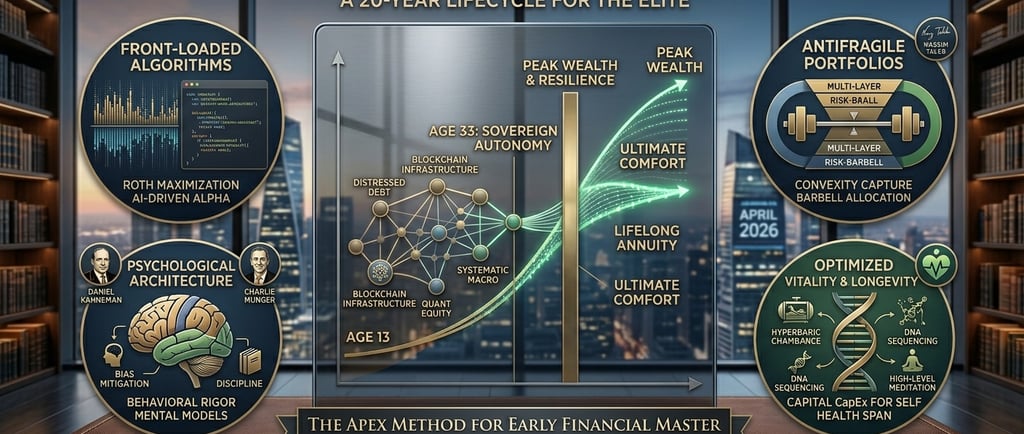
Phase 1 (Years 1-5) – The Alpha Phase: Focus on aggressive growth. As an adolescent, your "Time-to-Recovery" is effectively infinite. Allocate to high-beta assets, digital assets, and tech-heavy indices.
Phase 2 (Years 6-15) – The Accumulation Phase: Transition into "Barbell" strategies. Maintain a core of low-cost index funds while hunting for undervalued specific equities.
Phase 3 (Years 16-20) – The Preservation/Cash-Flow Phase: Shift toward dividend-growth stocks and high-yield instruments to generate the "Comfortable Reserve" required for long-term sovereignty.
Introduction
The pursuit of financial independence within a two-decade window—specifically starting during adolescence—is not merely an exercise in saving; it is an exercise in high-level financial engineering. To retire with "conforto, saúde, e boas reservas" (comfort, health, and robust reserves) by your mid-30s, one must move beyond retail-level advice and adopt the sophisticated frameworks utilized by the world’s most formidable capital allocators.
The Pillars of Radical Early Retirement
Retiring in 20 years requires a "compressed accumulation phase." While the average professional saves over 40 years, you are doubling the intensity. This necessitates:
Aggressive Savings Rate (ASR): Targeting a 50% to 70% savings rate of all income generated through early ventures or professional starts.
Asymmetric Risk/Reward: Utilizing the long-term horizon of an adolescent to capture "convex" returns in high-growth sectors, balanced by the stability of blue-chip equities.
Human Capital Optimization: Investing in high-income skills (Law, Engineering, Quantitative Finance) early to maximize the "seed capital" available for the market.
Titan Case Studies: The Architecture of Influence
To understand the market, one must study the architects of modern capital. These individuals do not just "invest"; they dictate market sentiment and structural shifts.
Warren Buffett (The Compounder)
Why he is influential: Buffett pioneered the concept of "Economic Moat." He taught the world that price is what you pay, but value is what you get.
The Lesson: For a 20-year plan, focus on high-quality companies with "sticky" products. Buffett’s influence stems from his discipline; he proves that avoiding mistakes is more profitable than finding "unicorns."
Ray Dalio (The Systematic Diversifier)
Why he is influential: Founder of Bridgewater Associates, Dalio introduced the "All Weather" portfolio. He views the economy as a "machine" with predictable cycles (deleveraging, inflation, growth).
The Lesson: Use Dalio’s "Holy Grail of Investing"—finding 15 to 20 uncorrelated return streams to reduce risk by 80% without sacrificing returns.
Howard Marks (The Risk Specialist)
Why he is influential: His "Memos to Clients" at Oaktree Capital are mandatory reading for institutional pros. He specializes in "Second-Level Thinking"—thinking differently and better than the consensus.
The Lesson: To retire early, you must be a contrarian. Buy when there is "blood in the streets" and remain cautious when the market is euphoric.
Ken Griffin (The Quantitative Titan)
Why he is influential: As the head of Citadel, Griffin represents the shift toward algorithmic and high-frequency dominance. His influence lies in liquidity provision and market-making.
The Lesson: Understand the role of technology and math in the modern market. Even a personal portfolio should be managed with data-driven rigor, not "gut feelings."
Essential High-Level Bibliography
To achieve a post-graduate level of financial literacy, these works are non-negotiable:
"The Intelligent Investor" (Benjamin Graham): The "Bible" of value investing. It establishes the psychological framework of "Mr. Market."
"Antifragile" (Nassim Nicholas Taleb): Crucial for understanding how to build a portfolio that actually benefits from chaos and market crashes.
"Principles" (Ray Dalio): A masterclass in creating systems for decision-making.
"Common Stocks and Uncommon Profits" (Philip Fisher): Focuses on the qualitative side—how to identify companies with massive growth potential before the crowd.
Implementation: The 20-Year Tactical Roadmap
Phase 1 (Years 1-5): The Alpha Phase. Focus on aggressive growth. As an adolescent, your "Time-to-Recovery" is infinite. Allocate to high-beta assets, Bitcoin, and tech-heavy indices.
Phase 2 (Years 6-15): The Accumulation Phase. Transition into "Barbell" strategies. Keep a core of index funds while hunting for undervalued specific equities.
Phase 3 (Years 16-20): The Preservation/Cash-Flow Phase. Shift toward dividend-growth stocks and high-yield instruments to generate the "Comfortable Reserve" required for the rest of your life.
Wealth is not the end goal; the end goal is the sovereignty of your time.
Final Synthesis: The Sovereign Conclusion
The transition from adolescent curiosity to institutional-grade wealth is a journey defined by intellectual rigor and temporal discipline. Achieving a full-scale retirement within a twenty-year window is an ambitious engineering feat that requires one to view capital not as a tool for consumption, but as a "force multiplier" for personal freedom. By the time you reach the conclusion of this twenty-year cycle, the objective is to have constructed a financial fortress so resilient that it generates perpetual liquidity, ensuring that your "Work Optional" status is backed by the same "Economic Moat" that Warren Buffett seeks in his most prized acquisitions.
Ultimately, the true measure of success in this 20-year blueprint is the preservation of your most finite assets: time and health. A robust portfolio provides the "Comfortable Reserve" necessary to navigate global economic shifts without anxiety, while the focus on physiological optimization ensures you are capable of enjoying that sovereignty for decades to come. As you implement these techniques—moving from the aggressive "Alpha Phase" of youth to the "Liquidity Transition" of your mid-30s—remember that you are not just building a bank account; you are engineering a life of total autonomy.
Conclusion: The Sovereign Blueprint
The transition from adolescent curiosity to institutional-grade wealth is defined by intellectual rigor and temporal discipline. Achieving a full-scale retirement within a twenty-year window is an engineering feat that views capital as a force multiplier for personal freedom. By the time this twenty-year cycle concludes, the objective is to have constructed a financial fortress so resilient that it generates perpetual liquidity, ensuring "Work Optional" status backed by the same "Economic Moat" that Warren Buffett seeks in his most prized acquisitions. Ultimately, you are not just building a bank account; you are engineering a life of total autonomy.
Selected Bibliography
Graham, B. The Intelligent Investor. (The foundational psychological framework of "Mr. Market").
Taleb, N. N. Antifragile: Things That Gain from Disorder. (Essential for building portfolios that benefit from market chaos).
Dalio, R. Principles: Life and Work. (A masterclass in decision-making systems).
Fisher, P. Common Stocks and Uncommon Profits. (Qualitative focus on identifying massive growth potential).
Marks, H. The Most Important Thing: Uncommon Sense for the Thoughtful Investor. (Advanced risk management and contrarian strategy).
Contact
Newsletter
contact@economicfinanceworldwide.com
Fone: +55 54 991220659
© 2026. All rights reserved. https://economicfinanceworldwide.com/privacy-policy