
The Bitcoin Paradox: Between Cyclic Maturation and Global Macro Dependency
Today
INVESTIMENTECONOMY
By marcelo Salamon
5/27/20264 min read
Executive Summary
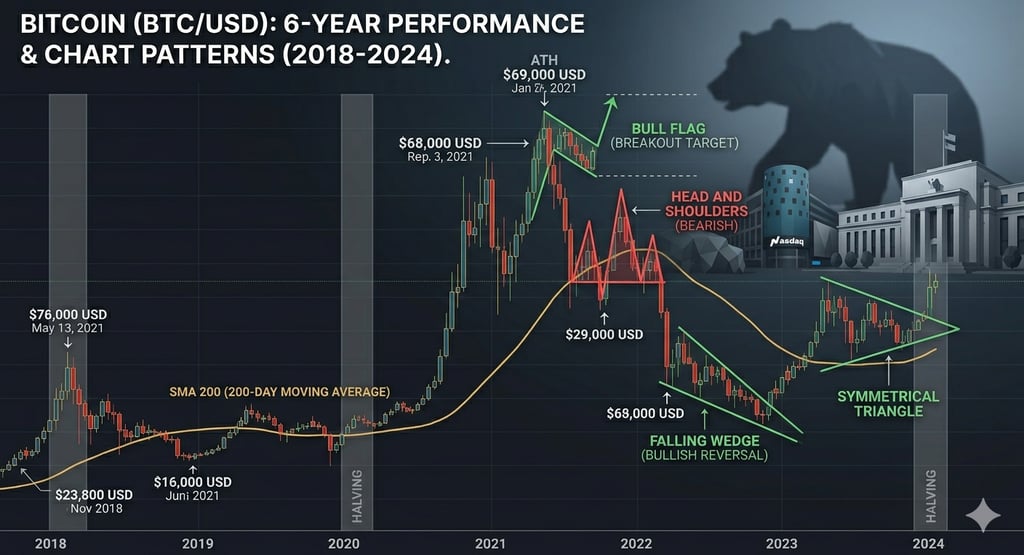
The digital asset market is currently navigating a period of profound technical and macroeconomic reassessment. Bitcoin (BTC), trading at approximately $75,122, is undergoing a prolonged phase of correction and sideways movement. After recording drawdowns exceeding 50% compared to previous cycles and consistently trading below its 200-day Simple Moving Average (SMA 200), the asset’s short-term outlook has shifted.
The "extended fifth wave" bullish narrative has lost momentum, giving way to a more complex structural maturation. Furthermore, Bitcoin’s high correlation with traditional U.S. markets—specifically the S&P 500 and tech-heavy Nasdaq—proves that it no longer operates in a financial vacuum. This report analyzes current technical dynamics, the influence of the new Federal Reserve leadership under Kevin Warsh, and price projections for the remainder of the year through optimistic, conservative, and realistic-pessimistic lenses.
Technical Context: Debunking the "Fifth Wave" and Market Reality
The technical narrative once driving optimism centered on an "extended fifth wave" moonshot. However, recent price action has invalidated this model:
Below the Critical Threshold: BTC has been trading below its 200-day SMA for months. In institutional trading, this is the definitive line between a Bull Market and a Bear Market.
Deep Corrections: Historically, a 50% retracement is more than a simple "dip"—it signals a cyclical reset. While painful, analysts suggest this is part of Bitcoin’s natural maturation as it seeks a solid floor before its next decade of growth.
The 2030 Horizon: Many institutional strategists believe Bitcoin is mirroring the early days of gold. By 2030, the asset is expected to achieve greater stability, but until then, it remains subject to the volatile "growing pains" of a global reserve asset in training.
The "Nasdaq-ification" of Bitcoin
Bitcoin’s independence has become a corporate myth. Today, BTC is a high-beta risk asset. Its price discovery is now inextricably linked to U.S. liquidity cycles:
Market Influence: When institutional investors de-risk due to geopolitical tension or inflation data (CPI), Bitcoin is sold off alongside the Nasdaq and S&P 500.
Digital Asset Exchange Ties: The dominance of U.S. spot ETFs means that Wall Street’s "opening bell" now dictates crypto liquidity. BTC is no longer just a "coin"; it is a tech-adjacent ticker highly sensitive to the Federal Reserve's balance sheet.
The Warsh Era: Federal Reserve Policy and Interest Rate Pressure
The transition of leadership at the Federal Reserve to Kevin Warsh (confirmed in May 2026) marks a pivotal moment for crypto:
Persistent Inflation: With April's CPI holding at 3.8% and core inflation re-accelerating, the Fed’s path to rate cuts has stalled.
The "Higher for Longer" Reality: Current Fed Funds rates sit between 3.50% and 3.75%. Market data from the CME FedWatch Tool suggests that instead of cuts, the market is now bracing for a potential rate hike by September.
The Impact: High interest rates strengthen the U.S. Dollar and Treasury yields, pulling capital away from "risk-on" assets like Bitcoin.
Outlook for Year-End 2026: Three Critical Scenarios
Current market consensus suggests that the "Crypto Winter" or sideways grind will likely persist through October 2026. A decisive move is expected only in the final quarter of the year or the first weeks of January 2027.
The Realistic / Bearish View (The "Reset" Target)
Projection: A break of current support levels, targeting $48,000, with a "worst-case" capitulation floor at $40,000.
Rationale: Some prominent analysts argue that the market needs to "flush out" excessive institutional leverage. A move to $48,000 would represent a 54% drawdown from recent local highs—a move that is statistically consistent with every prior Bitcoin cycle. If Kevin Warsh maintains a hawkish stance, a test of $40,000 could occur in the Fall (Oct/Nov) before a true bottom is formed.
The Conservative View (Sideways Consolidation)
Projection: BTC remains range-bound between $71,000 and $80,000.
Rationale: Inflation prevents a massive rally, but the massive "wall of money" from institutional ETFs provides a floor that prevents a total crash. The market enters a state of "boring" accumulation until early 2027.
The Optimistic View (The Q4 Resurgence)
Projection: A breakout above $82,000, aiming for $95,000+ by year-end.
Rationale: Historically, the fourth quarter is Bitcoin's strongest. If inflation data cools slightly by November, or if a "Santa Claus Rally" hits Wall Street, Bitcoin could catch a massive tailwind. In this scenario, the supply shock from the previous Halving finally outweighs the macro-selling pressure.
Final Thoughts & Author's Opinion
My take is that we are in a "purgatory phase." The market is likely to remain in this "winter" through October as it digests the new Fed leadership's policies. I believe the $48,000 level is a very realistic technical magnet that the market may want to test to confirm a long-term bottom. However, Bitcoin has a history of front-running the New Year; a recovery starting in late December or January 2027 is the most probable path for a sustained return to all-time highs.
References & Further Reading
Federal Reserve Board: Statement on the Confirmation of Chair Kevin Warsh (May 2026).
Bureau of Labor Statistics: Consumer Price Index Summary - April 2026 Results.
Binance Square / NoLimit Analysis: The Cycle Reset: Why $40K-$48K is the Technical Target.
Goldman Sachs Digital Assets Research: Institutional Flows and the Maturation of BTC (Q1 2026 Review).
CFR (Council on Foreign Relations): What to Expect From Kevin Warsh’s Fed in the First 100 Days.
Contact
Newsletter
contact@economicfinanceworldwide.com
Fone: +55 54 991220659
© 2026. All rights reserved. https://economicfinanceworldwide.com/privacy-policy