
The Day Space Invaded Wall Street: What to Expect from the Historic SpaceX IPO
Blog post description.
INVESTIMENT
6/11/20266 min read
Introduction
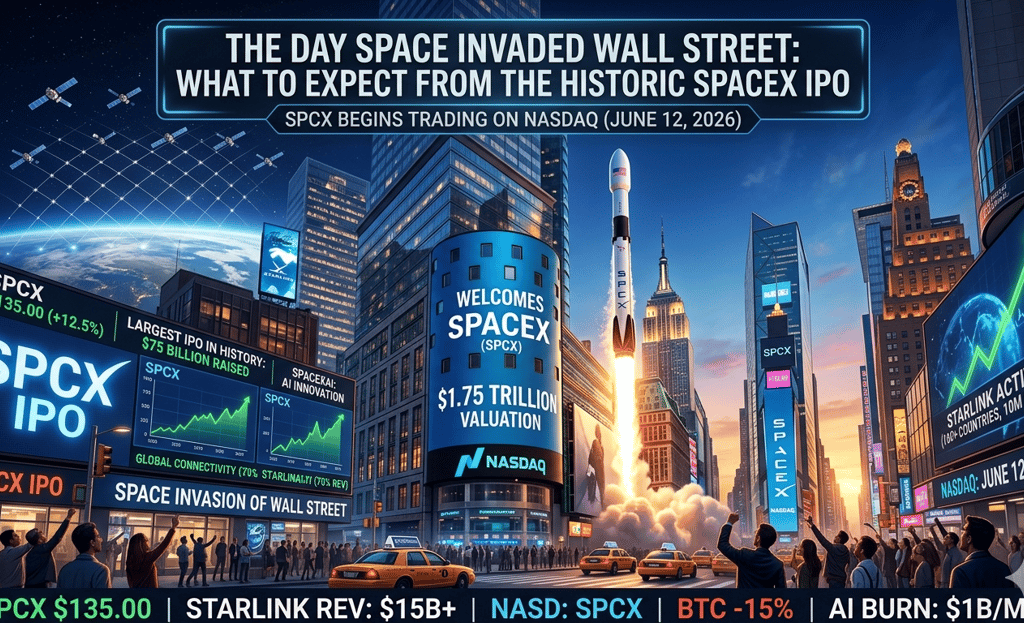
The global financial market is on the verge of witnessing a milestone that will redefine the boundaries of tech capitalism. Tomorrow, Friday, June 12, 2026, SpaceX will make its official debut on the Nasdaq under the ticker SPCX. With the final pricing occurring today, June 11, the expectations built behind the scenes in New York point toward an unprecedented market event.
After filing its Form S-1 with the Securities and Exchange Commission (SEC) on May 20, 2026, the Elon Musk-led company set an audacious target: a market valuation of $1.75 trillion, seeking to raise $75 billion through the offering. For historical perspective, these figures shatter the previous record held by oil giant Saudi Aramco, which raised $29.4 billion in 2019. This is categorically the largest IPO in human history—an event that promises to test the liquidity and risk appetite of investors worldwide.
Today’s Numbers: The Capital Entering the Market
In pre-market trading ahead of the official opening bell, SPCX indicators already point to an impressive baseline. At this exact moment, the stock is signaling trades around $135.00, which pushes the company's implied market cap to the $1.77 trillion mark—slightly above the initial S-1 filing target.
Institutional investors justify this massive valuation by pointing to the near-monopoly the company holds over aerospace infrastructure. However, fundamental analysts urge caution when dissecting the financial multiples. Paying $1.75 trillion means the market is accepting a valuation of roughly 95 times its 2025 sales, which closed at $18.7 billion (a 33% growth year-over-year). This represents an incredibly steep growth premium, especially for a corporation that, despite its billion-dollar revenue, recently posted a net loss of approximately $4.9 billion.
The Engine Behind the Valuation: Where Cash Flows and Where It Burns
To understand whether this nearly two-trillion-dollar market cap can be sustained in the medium to long term, it is crucial to break SpaceX down into its three primary operational divisions, each running on completely different financial dynamics:
Starlink (The Crown Jewel): This is the only segment of the group operating with consistently positive cash flow and robust operational results. Starlink currently accounts for 70% of SpaceX's total revenue. Operating in over 160 countries and having surpassed 10 million active users in the first quarter of 2026, the satellite internet division has projected revenues between $15.9 billion and $24 billion for this year, according to firms like Bloomberg and Quilty Space. In isolation, the global connectivity business could sustain a valuation ranging from $500 billion to $800 billion.
Launch Division (The Technical Core): SpaceX maintains an absolute 80% market share of the global satellite launch and space mission market. Its reusable rockets revolutionized the industry, but the operation itself consumes massive volumes of capital. It remains an structurally cash-burning arm required to maintain technological vanguard and market leadership.
SpaceXAI (The Billion-Dollar AI Bet): Created following the acquisition of xAI in February 2026, this division encompasses the X social platform, the Grok large language model, and a massive supercomputing infrastructure. While it injects a highly valued AI narrative into the company's growth story, SpaceXAI burns an estimated $1 billion per month, racking up $7.7 billion in capital expenditures (CapEx) in the last quarter alone. This financial weight was the primary driver behind the recent negative impact on the consolidated balance sheet.
Scenarios for Tomorrow: Liquidity Boom or a Reality Check?
How SPCX shares will behave starting tomorrow divides major global trading desks into two distinct analytical camps:
The Bull Case: Proponents of the growth thesis argue that a successful IPO will draw an unprecedented torrent of institutional capital into cutting-edge technology, defense, and aerospace sectors. Establishing SpaceX as a publicly traded corporation will act as a catalyst to lift global tech indices and ETFs tied to innovation and artificial intelligence, triggering a virtuous cycle of liquidity.
The Bear Case: Independent research firms adopt a significantly more sober stance. Morningstar, for instance, evaluates the company's "fair value" at $780 billion—less than half of the target IPO price. The history of mega tech listings offers stark warnings: Uber suffered a 34% drop in its first year, while Rivian plummeted 82%. There is also a concentrated corporate governance risk: the dual-class share structure ensures Elon Musk retains absolute voting control. Consequently, reputational swings or controversies tied to the founder are highly likely to reflect directly in the stock price, regardless of the company's technical fundamentals.
The Day 1 Verdict: Trying to guess the exact direction of the stock chart during the first few hours of trading is pure speculation. In the short run, the market is a voting machine (driven by hype and order flow); in the long run, it is a weighing machine (driven by earnings and cash flow). For the strategic investor, whether the stock closes its first day up 20% or down 15% matters very little. The real focus should be observing how well the market digests the structural cash burn of the AI division over the coming quarters.
The Secondary Ripple: The Domino Effect on Risk Assets and Crypto
One of the most fascinating dynamics of this event is how the sheer scale of SpaceX is creating shockwaves in markets that seem theoretically distant. To raise the tens of billions of dollars required to subscribe to SPCX shares—and to prepare for the subsequent OpenAI and Anthropic IPOs slated for later in 2026—major venture capital funds and high-net-worth retail investors are aggressively reallocating portfolios.
This movement has triggered a visible liquidity drain from traditional risk assets. The cryptocurrency ecosystem was the first to feel the impact of this capital competition. Over the past week, Bitcoin registered a sharp 15% devaluation, marking its worst weekly performance since the collapse of the FTX exchange in November 2022. Market experts point out that digital assets and hyper-growth tech stocks compete for the exact same pool of global venture capital. In the short term, the gravitational pull of the Nasdaq seems to be winning the tug-of-war.
The Global Investor’s Perspective: The Search for Legal Security and Freedom
Analyzing this historic moment through a purely local lens makes little sense in the contemporary financial landscape. Modern investors operate globally, utilizing international platforms to manage their assets directly. This wealth migration has evolved beyond simple currency diversification into a legitimate wealth preservation strategy driven by deep structural factors.
Allocating capital into stable foreign jurisdictions functions as a shield against domestic environments marked by fiscal volatility, heavy tax burdens, and the erosion of individual privacy and legal security. By moving the majority of their wealth to mature markets, investors seek protection against arbitrary state interventions and inflationary depreciation.
Within this global allocation framework, investing in equities like SPCX must be guided by mathematical rationality and strict risk management. Because it is an asset that couples a monopoly on orbital infrastructure with heavy cash-burning AI operations, the consensus among international fund managers suggests treating it as pure risk capital. The recommended approach is to limit allocation to a range between 5% and 10% of the portfolio slice explicitly dedicated to aggressive growth assets, establishing a firm 5-to-7-year time horizon for the investment to mature.
Conclusion: Innovation Meets Market Maturity
The SpaceX IPO is not just the listing of another tech company; it is the coronation of a new economic and industrial ecosystem. By opening global satellite communications and the future of interplanetary transport to public trading, Wall Street is pricing the core infrastructure of the 21st century.
The complexity of this moment lies in the delicate balance between a revolutionary engineering vision and cold, hard cash flows. The fusion of Starlink's commercial success with the multi-billion-dollar losses stemming from the AI race creates a fascinating investment dynamic. While centralization under Elon Musk brings inherent volatility, it offers global investors a unique opportunity to own a piece of the most disruptive innovation engine ever unified under a single holding company.
For global investors who understand the necessity of keeping their capital protected in strong markets away from regional political instabilities, tomorrow will serve as a watershed moment. The financial world is about to decide whether it validates the thesis that SpaceX is worth every penny of its nearly two-trillion-dollar price tag, or if accounting gravity will pull expectations back down to Earth. Regardless of the immediate outcome, one certainty remains: the boundary between Earth and the financial frontier has changed forever.
References
BLOOMBERG BUSINESSWEEK. Starlink: Revenue Projections and Global Satellites Market Share Analysis (Q1 2026). Market Intelligence Report, May 2026.
CNN BRASIL. The SpaceX Effect: How the Largest IPO in History is Draining Liquidity from Crypto Assets and Impacting Bitcoin. International Finance Section, published June 2026.
INVESTING.COM. SPCX Financial Statements: Deep Dive into SpaceXAI CapEx, xAI Integration and Nasdaq Pre-Market Valuation. Real-time balance sheet and market data, accessed June 11, 2026.
LET’S MONEY. The Engine of Space Capitalism: Starlink Cash Flow and the Financial Burn Rate of Launches. Portfolio and Venture Capital Analysis, June 2026.
MORNINGSTAR RESEARCH. SpaceX Fair Value Assessment: Valuation Models vs. Market Premium. Equity Research Technical Report, issued June 2026.
RANKIA GLOBAL. SpaceX S-1 Filing Analysis: From Saudi Aramco Record to the $1.75 Trillion Target. Investor Guide and Historic IPO Analysis, published May/June 2026.
SECURITIES AND EXCHANGE COMMISSION (SEC). Form S-1 Registration Statement Under The Securities Act of 1933: Space Exploration Technologies Corp. Official Public Offering Filing, Washington D.C., May 20, 2026.
WEEX MARKET INSIGHTS. Global Connectivity and Retail Trading: Starlink's 10 Million Users Milestone and the Tech Sector Impact. Sector Report, 2026.
Contact
Newsletter
contact@economicfinanceworldwide.com
Fone: +55 54 991220659
© 2026. All rights reserved. https://economicfinanceworldwide.com/privacy-policy