
The $100 Barrel: How the Trump-Israel Alliance is Reshaping Global Markets
The impact of the conflict in the global oil iprices
Salamon and Salamon
3/2/20263 min read
Executive Summary
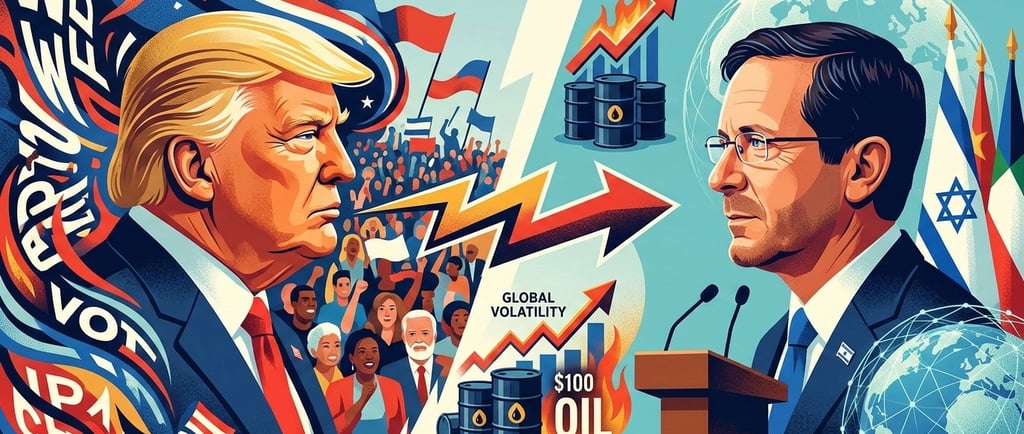
The global economy is currently navigating a period of unprecedented volatility driven by the escalating tensions in the Middle East and the assertive "Peace through Strength" doctrine championed by the Trump administration. Following the launch of Operation Epic Fury in early 2026, which systematically dismantled key Iranian military infrastructure, the global energy and trade landscape has been fundamentally reshaped. Brent crude prices surged by over 40% in March 2026, peaking near $120 per barrel, as markets grappled with the prospect of prolonged instability. This report synthesizes the interplay between high-stakes military maneuvers, shifting diplomatic alliances, and the resulting economic strain, characterized by inflationary pressures and supply chain disruptions. As the world transitions toward a "new normal" in 2026, investors face a market where geopolitical risk is not merely an external factor, but the primary driver of fiscal and monetary outcomes.
Introduction
The global economy is currently caught in a high-stakes game of geopolitical chess. As of mid-2026, the combined influence of President Donald Trump’s decisive military operations and President Isaac Herzog’s diplomatic offensive has moved beyond the headlines and directly into the world’s trading pits. For investors, the "war premium" is no longer a theoretical construct—it is a daily reality reflected in the volatility of commodity markets and the recalibration of long-term economic forecasts.
The Trump Doctrine: From Rhetoric to Kinetic Action
President Trump’s "Peace through Strength" strategy culminated in Operation Epic Fury, a decisive campaign that neutralized Iran's ballistic missile capabilities and naval power within 38 days. While these actions were designed to eliminate the regime's ability to threaten global energy chokepoints, the financial markets initially responded with intense volatility. The VIX (Volatility Index) saw significant spikes during the height of the combat operations, as investors weighed the benefits of long-term regional stability against the immediate, tangible shocks of large-scale military conflict.
President Herzog and the Maritime "Iron Wall"
On the diplomatic front, Israeli President Isaac Herzog has led a sophisticated campaign to frame Israel's operations as essential for global maritime security. By emphasizing the threat to the Red Sea and the Strait of Hormuz, Herzog successfully aligned Israel’s security needs with the global imperative for open trade. His diplomatic tours, including historic visits to Panama and beyond, have underscored a new reality: the protection of global maritime lanes is now the central pillar of 2026 security policy. This "Iron Wall" strategy, while successful in gathering international support, has also signaled to markets that the elevated military presence in these strategic waters is intended to be a permanent fixture for the foreseeable future.
The Crude Reality: Oil as a Geopolitical Weapon
The most sensitive nerve in this scenario remains the price of oil. As the world's primary energy provider, the Middle East’s volatility acts as an immediate tax on the global economy.
The Supply Squeeze: The crisis at the Strait of Hormuz drove Brent crude toward $120 per barrel in March 2026. Despite later stabilization following the ceasefire, the "risk premium" remains historically high.
Petro-Dollar Dynamics: A surging U.S. Dollar, acting as a safe-haven asset, has simultaneously increased the cost of energy imports for developing nations, creating a secondary ripple of economic cooling across emerging markets.
Inflation and the Federal Reserve: For the American consumer, the cost of these tensions is visible at the pump. With energy costs remaining elevated, the Federal Reserve’s battle against inflation has faced significant resistance, cementing a "higher for longer" interest rate environment that continues to exert downward pressure on corporate borrowing and housing markets.
Conclusion
As we navigate the remainder of 2026, the intersection of assertive foreign policy and tactical military necessity has created a market environment where risk is the only constant. The primary question for financial analysts is whether the global supply chain can withstand sustained periods of regional tension. While Operation Epic Fury has achieved its core military objectives, the fiscal consequences—inflation, high interest rates, and energy price sensitivity—will define the economic legacy of this year. Investors must remain vigilant, as the world continues to watch the trading tickers as closely as they monitor the shifting geopolitical map.
Note: This article is current as of June 14, 2026.
Selected Bibliography
The White House. Peace Through Strength: Operation Epic Fury Crushes Iranian Threat. (April 2026).
Government of Israel. President Herzog’s Diplomatic Mission: Maritime Freedom and Regional Security. (May 2026).
TASS / Kazinform. Brent Crude Oil: Analysis of the 40% Surge in Q1 2026. (April 2026).
J.P. Morgan Global Research. Commodity Balances and Geopolitical Risk Premiums in 2026. (2026).
Contact
Newsletter
contact@economicfinanceworldwide.com
Fone: +55 54 991220659
© 2026. All rights reserved. https://economicfinanceworldwide.com/privacy-policy