
The Four Ideologies of Bitcoin: Navigating the End-of-Cycle Correction
Bitcoin
INVESTIMENT
By Marcelo Salamon
6/8/20264 min read
Abstract
This article examines the current state of the Bitcoin market through the lens of Michael Saylor’s recent essay, "The Four Ideologies of Bitcoin," integrated with the traditional four-year halving cycle. As of June 2026, the market is navigating significant headwinds, including speculative capital rotation into AI equities and ongoing macroeconomic uncertainty. By analyzing institutional behaviors—most notably MicroStrategy’s recent $101.3 million accumulation—we provide a framework for understanding the potential for a deeper technical correction toward the $48,000 level and what this means for the long-term maturation of the digital asset space.
Introduction: A Critical Inflection Point
The crypto market in mid-2026 is at a technical and psychological crossroads. The optimism that fueled the earlier months of the year has been met with a sharp, disciplined correction, often misunderstood by retail participants as a failure of the asset's underlying thesis. However, a rigorous analysis of the four-year cycle suggests we are merely experiencing a necessary phase of deleveraging.
Michael Saylor’s recent essay, "The Four Ideologies of Bitcoin," offers a necessary roadmap for this period. By categorizing the internal forces driving the Bitcoin community, Saylor moves the conversation beyond daily price action and toward the structural evolution of the protocol. This article dissects these forces, the institutional response to market volatility, and the mathematical probabilities surrounding the current cycle as we head toward October 2026.
The Four Ideologies: The Architecture of Resilience
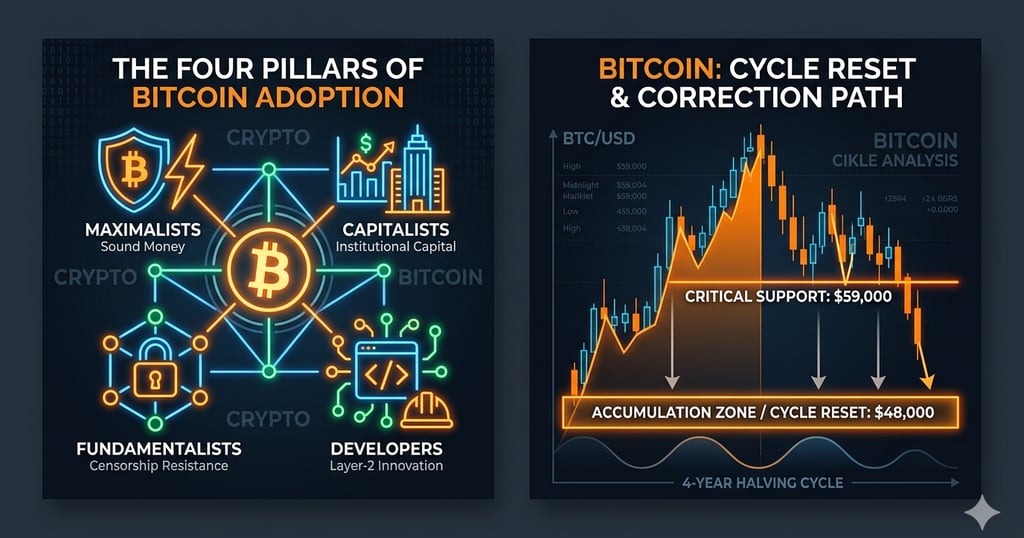
Saylor identifies four distinct yet interdependent pillars that support Bitcoin’s global adoption:
Bitcoin Maximalists: Guardians of absolute scarcity and the "moral clarity" of sound money. They serve as the ideological bedrock that prevents Bitcoin from being diluted by other projects.
Bitcoin Capitalists: The institutional engine—represented by firms like MicroStrategy—that integrates Bitcoin into global banking, capital markets, and corporate balance sheets.
Bitcoin Technologists: The developers driving the scalability and security of the protocol through Layer-2 innovations like the Lightning Network.
Bitcoin Fundamentalists: The purists prioritizing self-custody and decentralization to ensure the network remains censorship-resistant and immune to regulatory capture.
The market’s recent reaction to "rumors" of Bitcoin sales by MicroStrategy serves as a case study for this ideological tug-of-war. Despite short-term speculation, MicroStrategy’s actual behavior—purchasing an additional 1,550 BTC for $101.3 million last week—reaffirmed their commitment to the Treasury strategy. This action demonstrated that institutional conviction is not moved by weekend price swings or minor accounting sales, but by a long-term capital allocation strategy.
Market Reality: The Four-Year Cycle and the Case for $48,000
The narrative of "extended cycles" has lost its momentum. The Bitcoin price action throughout 2026 is tracking closely with the traditional four-year structure. The failure to hold the $59,000 support level on the second attempt is a classic technical signal that the market requires a deeper "flush" of leveraged positions.
Historical data suggests that Bitcoin rarely enters a new phase of exponential growth without first testing levels of deep structural liquidity. While a return to $71,000 would be welcomed by bulls, the current on-chain metrics—such as the Realized Price and the MVRV Z-Score—indicate that there is still excessive leverage within the system. A correction toward the $48,000 range is not a sign of failure; it is the "cleansing" necessary to reset the cost basis for the next cycle.
Projections and Probabilities: Paths to October 2026
We have modeled three scenarios for the market’s behavior leading into the final quarter of the year:
Capitulation & Accumulation (50% probability): A clean break below $59,000 leads to a retest of the $48,000–$50,000 zone. This serves as the cycle’s final bottom, where the market lateralizes for several weeks, allowing for a strong, institutional-led consolidation before the next leg up.
Extended Lateralization (30% probability): Bitcoin maintains a choppy range between $60,000 and $65,000. Institutional buyers continue to defend the current level, preventing a deep drop, but a lack of macro-economic catalysts prevents an immediate breakout.
The "Bull Trap" Reversal (20% probability): A sharp, liquidity-driven rally toward $71,000 attracts late-cycle retail buyers, only to be met with a swift rejection as the macro-economic environment restricts capital flows.
Strategic Reflection: Price vs. Value
The most important lesson for the reader is the distinction between price and value. The $48,000 and $59,000 levels are temporary data points. The network, the descentralization, and the technological utility of the protocol continue to advance regardless of the dollar-denominated price.
When firms like MicroStrategy accumulate during price dips, they aren't "timing the market"; they are executing a thesis that the value of decentralized, incorruptible money will inevitably supersede the inflationary nature of fiat-based debt markets. For the individual investor, the challenge is emotional resilience. Volatility is the entry fee for an asset class that is sovereign, stateless, and globally accessible.
Conclusion: The Implacability of the Cycle
The close of the 2026 cycle in October will be viewed in hindsight as a pivotal moment of maturation. The volatility that creates anxiety today will, in the future, be recognized as the optimal accumulation window for those with the patience to hold through the "washout." Bitcoin does not force a choice between cypherpunk ethics and Wall Street efficiency; it requires the understanding that both are necessary components of a new global financial architecture. A dip toward $48,000—should it manifest—is the final recalibration of an engine destined for long-term growth.
DISCLAIMER
This content is for informational purposes only and does not constitute financial advice, investment recommendations, or an offer to buy or sell securities. The cryptocurrency market involves high risk and extreme volatility. Price projections are based on historical cycle models and current market conditions and are subject to change. Investors should perform their own due diligence and consider their individual risk tolerance before making any investment decisions.
Bibliography
Saylor, M. (2026). The Four Ideologies of Bitcoin. MicroStrategy Research.
Strategy Inc. (2026). Form 8-K: Bitcoin Acquisition and Dividend Schedule Amendments.
Fidelity Investments (2026). Bitcoin 4-Year Halving Analysis & Market Cycles.
Glassnode Research (2026). On-Chain Market Dynamics: Realized Price and Cap Flows.
Woo, W. (2026). Cycle Maturity and Valuation Models.
Federal Reserve (2026). Global Liquidity & Macroeconomic Policy Review.
Contact
Newsletter
contact@economicfinanceworldwide.com
Fone: +55 54 991220659
© 2026. All rights reserved. https://economicfinanceworldwide.com/privacy-policy