
The Middle East in 2026: Fact vs. Fiction and the Impact on Global Markets
Macroeconomic Scenario analysis
ECONOMY
By Marcelo Salamon
6/30/20265 min read
Executive Summary
This briefing analyzes the Middle Eastern geopolitical landscape during the first half of 2026, breaking down the operational dynamics of two distinct conflicts often conflated in digital media: the Gaza deadlock (Israel vs. Hamas) and the strategic escalation between the US/Israel coalition and Iran. We evaluate the direct macroeconomic repercussions on Brent crude prices, gold futures, US dollar volatility, and risk assets—including global equity markets and Bitcoin. Additionally, this report analyzes the convergence of global geopolitical shocks with the cryptocurrency market's scheduled cyclical correction for the remainder of the year. We conclude with quarterly projections grounded in probabilistic scenarios to support asset allocation decisions.
Keywords: Middle East 2026; Geopolitical Risk; Brent Crude; Bitcoin Cycles; Cyclical Correction.
Introduction
The global macroeconomic outlook in 2026 remains deeply tied to energy sector price stability and the perception of systemic risk stemming from geopolitical friction zones. Historically, the Middle East has acted as the primary catalyst for commodity market volatility due to its logistical importance and hydrocarbon production. However, today's fast-paced digital media environment often creates severe analytical noise by blending distinct political events and timelines into a single narrative of a generalized crisis.
For institutional investors and financial strategists, surgically separating factual reality from informational noise (fake news) is imperative for pricing assets accurately and mitigating tail risk. This briefing breaks down the military and diplomatic architecture of mid-2026, mapping the transmission channels that connect events in the Persian Gulf and the Levant directly to the behavior of global investment portfolios.
The Duality of the Crises: Separating Operational Theaters
[ MIDDLE EAST CONFLICTS - 2026 ]
┌──────────────┴──────────────┐
▼ ▼
[ GAZA: ISRAEL vs. HAMAS ] [ REGIONAL CRISIS: US/ISRAEL vs. IRAN ]
• Fragile partial ceasefire • Interim Memorandum of Understanding (Swiss)
• Phase 2 stalled (Disarm) • Critical 60-day window (Expires Aug/Sept)
• Israeli military control • Escalation risks with Hezbollah
over 50%+ of the region • Core focus: Uranium & Strait of Hormuz
The first track is Gaza. Although international diplomats celebrated the signing of Phase 1 of a 20-point plan in Sharm el-Sheikh in late 2025, data collected from multilateral agencies confirm that low-intensity hostilities persist. Hamas's refusal to accept full disarmament terms and the maintenance of defensive positions by the Israel Defense Forces create a status quo of operational and diplomatic paralysis that stabilizes local risk without eliminating it.
The second track, which carries far greater global financial contagion power, involves the temporary Memorandum of Understanding signed on June 19, 2026, in Switzerland. Mediated by Qatar and Pakistan, it aims to temporarily halt direct military escalation between the US and Iran. This document is provisional and established a 60-day window to negotiate a definitive treaty. The fragility of this agreement is underscored by frictions recorded immediately after its signing, signaling that compliance with the timeline through the end of the quarter will occur under severe speculative stress.
Macroeconomic Transmission: Financial Seesaw Dynamics
The channels through which geopolitical risk transmits to financial assets operate with high technical fidelity in 2026. Markets respond instantly to signals from operational theaters through automated safety-seeking or yield-chasing flows.
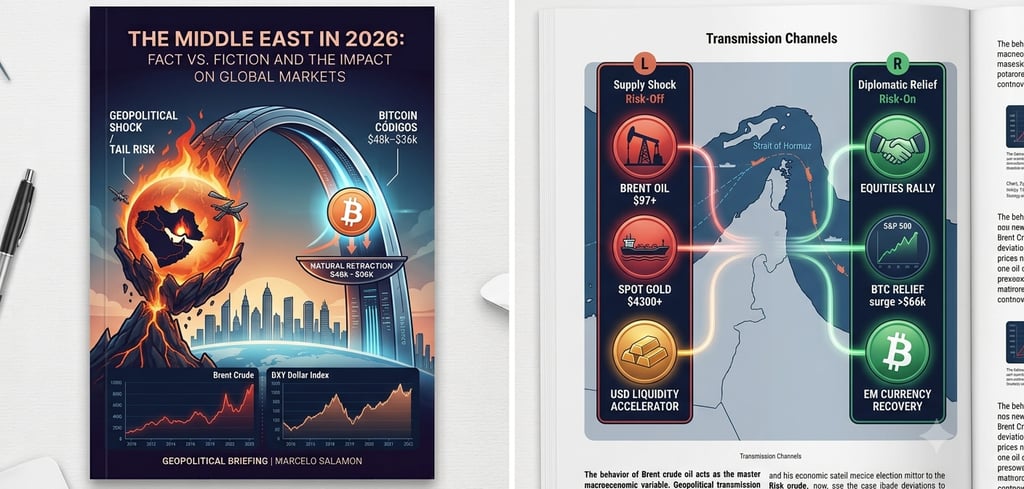
Asset ClassDuring Military Escalation (Risk-Off)During Diplomatic Progress (Risk-On)
Brent Crude OilSpikes rapidly, testing peaks above $97 on Strait of Hormuz risks.Stable downward fluctuation, receding to the $73 to $80 range.
Spot GoldConsistent growth above $4,300/oz as the primary tangible store of value.Sideways stabilization or short-term profit-taking.
US Dollar (DXY)Strengthens globally due to flight-to-liquidity and safety flows.Relative depreciation against emerging market currencies.
Equities & BitcoinSharp sell-offs (Bitcoin pulls back to the $60,000 - $64,000 range).Liquidity recovery and relief rallies (Bitcoin surges above $66,000).
The behavior of Brent crude oil acts as the master macroeconomic variable. Upside deviations in barrel prices impact global supply chains by increasing logistical costs, driving inflationary pressures that force central banks to keep monetary policies restrictive. Asset volatility directly reflects the perceived degree of institutional fragility across global energy shipping choke points.
Bitcoin and Digital Assets: Geopolitical Shocks Meet the Natural Correction Cycle
Bitcoin's performance throughout 2026 offers a unique perspective on the institutional maturity of this asset class. While long labeled by enthusiasts as "digital gold," market dynamics in 2026 have solidified the asset as a pure gauge of global liquidity and risk appetite. From a long-term technical and mathematical standpoint, Bitcoin is currently undergoing a natural, expected post-halving cyclical retraction. This organic cycle dictates a prolonged, corrective downward trend, projecting a search for liquidity in historical macroeconomic support zones estimated between $48,000 and $36,000 through October 2026.
The correlation between this structural cycle and the kinetic crises in the Middle East deeply affects short-term volatility without altering Bitcoin's long-term mathematical trajectory. On days marked by direct military strikes or broken diplomatic agreements, Bitcoin suffers sharp liquidations into the $60,000 to $64,000 range, driven by forced margin calls as leveraged traders scramble for US dollar liquidity. Short-term investors frequently misinterpret these geopolitical events as the sole cause of the decline; in reality, they act merely as accelerators of a technical correction already hardcoded into the ecosystem's natural cycle.
"Consequently, diplomatic developments in the Persian Gulf do not invalidate cryptocurrency market prospects—they recondition them. If the Swiss Memorandum of Understanding evolves into a definitive treaty next quarter, the resulting relief rally will provide the momentum needed for Bitcoin to hold the upper floor of its macro correction. Conversely, a collapse in negotiations and a subsequent oil shock will accelerate technical capitulation toward the cyclical low of $36,000. This convergence proves that geopolitical events operate as volatility triggers that test the structural resilience of supports established by the natural cycle.
Probabilistic Scenarios for the Next 90 Days
The expiration of the interim Iran-US memorandum concentrates the primary inflection points for the coming quarter. Three mutually exclusive scenarios are mapped out to guide risk positioning:
Scenario A: Diplomatic Resolution and Final Treaty (Moderate Probability) Uranium dilution terms are ratified by Iran under IAEA supervision. Impact: Brent crude falls back to structural levels below $80, the dollar weakens globally, and equity and crypto markets experience a broad expansion as capital rotates back into risk assets, cushioning Bitcoin's natural retraction.
Scenario B: Ongoing Deadlock with Technical Extension (High Probability) The parties fail to sign a definitive text within 60 days but agree to extend the memorandum by consensus for an additional 30 to 60 days. Impact: Continued intermittent volatility ("nervous waiting"). Bitcoin continues to drift sideways within tight channels, following its slow, gradual downward schedule toward October.
Scenario C: Terms Breach and Kinetic Escalation (Low-to-Moderate Probability) Severe disruptions occur in commercial shipping through the Strait of Hormuz, or attacks resume on strategic infrastructure. Impact: An energy sector supply shock pushes Brent crude toward the $90–$100 range. Safe-haven hedges trigger immediately in gold (above $4,300), while global stock indices correct sharply, forcing Bitcoin to test its cyclical lows between $48,000 and $36,000 on an accelerated timeline.
Conclusion
The global geopolitical architecture of 2026 demands a strictly empirical analytical approach from economic operators, insulated from speculative digital media narratives. The clear distinction between the conflicts in Gaza and Iran proves that real systemic risk is not centered on the existence of hostilities themselves, but rather on the fragility of international memorandum timelines and the vulnerability of global logistical choke points like the Strait of Hormuz.
Integrating new asset classes like Bitcoin reveals that endogenous, cyclical crypto market variables compound traditional exogenous geopolitical shocks. Understanding that the projected decline through October is part of a healthy structural cleanup within the market cycle prevents investors from making emotional decisions based on temporary international fluctuations.
For practical allocation and wealth management purposes, continuous monitoring of front-month crude oil futures remains the most efficient alarm mechanism. With critical diplomatic rounds concluding over the next 90 days, strategies focused on currency hedging and diversification into low-correlation defensive assets appear prudent to shield portfolios against tail-risk shifts in the Middle Eastern balance of power.
References
ACLED. (2026). Regional Conflict Trends: Middle East Operational Analysis Q1-Q2 2026. Armed Conflict Location & Event Data Project.
IAEA. (2026). Implementation of the Verification and Monitoring Memorandum in the Islamic Republic of Iran. Technical Report by the International Atomic Energy Agency, June 2026.
Bloomberg Professional Services. (2026). Geopolitical Risk Index & Commodity Price Transmission Models. Market data and analytics retrieved June 2026.
UNITED NATIONS (UN). (2026). Report on Humanitarian Monitoring and Ceasefire Compliance in the Occupied Gaza Territory. UN Security Council.
Contact
Newsletter
contact@economicfinanceworldwide.com
Fone: +55 54 991220659
© 2026. All rights reserved. https://economicfinanceworldwide.com/privacy-policy