The Paraguayan Economic Phenomenon
Fiscal Stability, Investment Magnetism, and Human Development Hurdles
HISTORICAL ANALYSIS
By Marcelo Salamon
7/26/20267 min read
Executive Summary
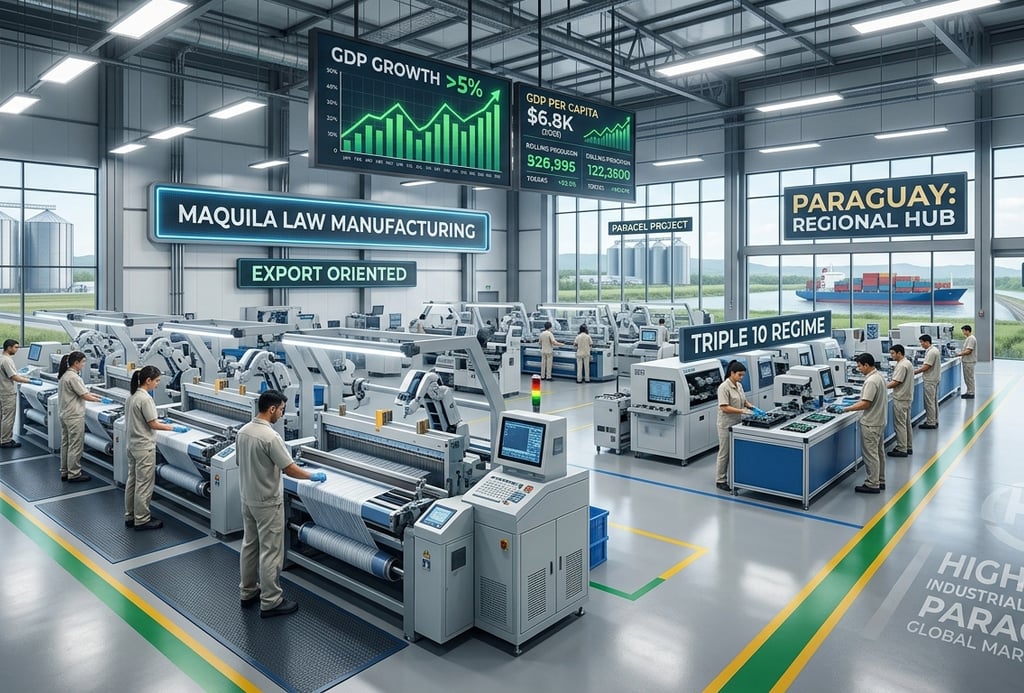
This article examines Paraguay’s socioeconomic development over the past two decades, highlighting its transition from an agrarian economy into a dynamic industrial hub and a key target for Foreign Direct Investment (FDI) in Latin America. Backed by strict fiscal responsibility, monetary stability, and a highly competitive tax incentive framework—anchored by the "Triple 10" system and the Maquila Law—the nation has achieved an Investment Grade credit rating. This analysis covers recent Gross Domestic Product (GDP) trends, per capita income growth, labor market dynamics, the incoming industrial ecosystem, and major regional infrastructure projects. Finally, it critically evaluates Paraguay’s Human Development Index (HDI) trajectory and the realism of its prospective position in regional social rankings.
Keywords: Economy of Paraguay; Maquila Law; Economic Growth; Investment Attraction; Human Development Index.
Introduction
Over the past two decades, Paraguay has cemented one of the most stable and predictable macroeconomic models in South America. In a region historically plagued by political volatility, recurring currency crises, and fiscal shocks, Asunción’s pragmatic policy framework has cultivated a fertile environment for business operations and productive capital inflows.
Driven by strong performances across strategic sectors—including agribusiness, electric power generation, construction, and a rapidly expanding services industry—the country has consistently beaten GDP growth forecasts. The cornerstone of this transformation rests on a balanced mix of rigorous fiscal discipline, low tax burdens, and regulatory predictability. This environment has turned Paraguay into a primary target for foreign multinationals, particularly Brazilian manufacturers seeking cost efficiencies and supply chain optimization.
This paper examines the structural foundations of this sustained expansion. It reviews key macroeconomic indicators from 2005 through 2025, active tax regimes, the composition of the industrial park, forward-looking integration megaprojects, and the persistent structural bottlenecks in human and social development.
Economic Trajectory and Macroeconomic Indicators (2005–2025)
Paraguay’s macroeconomic path stands out in Latin America for its consistency. While neighboring giants navigated prolonged recessions or sluggish growth, Paraguay expanded at rates well above the regional average. In the first half of 2025 alone, the country posted cumulative GDP growth of 5.9%, signaling robust momentum.
Consequently, the Central Bank of Paraguay (BCP) revised its annual GDP growth forecast upward from 4.0% to 5.3%, with recent consolidated data showing peaks as high as 6.6%. In absolute terms, this growth trajectory has expanded the total size of the Paraguayan economy to an estimated $47.4 billion to $48.6 billion.
GDP Per Capita and Income Evolution
Economic expansion has translated directly into higher average per capita income:
2005 Baseline: GDP per capita stood at roughly $1,500.
2025 Level: Following two decades of steady gains, official data and World Bank estimates place Paraguayan GDP per capita between $6,455 and $7,580 (with a World Bank baseline average of approximately $6,800).
Total GDP Expansion: The aggregate economy expanded from approximately $9.0 billion in 2005 to between $47.4 billion and $48.6 billion by 2025.
Poverty Reduction: The overall national poverty rate fell sharply over the 20-year period, dropping from over 40.0% to 17.9% in the latest official figures.
Labor Market Dynamics and Informality
While economic growth has noticeably reduced poverty, the labor market faces a deep structural headwind: widespread informality.
Although the labor force participation rate remains relatively high at 61% to 63%, an estimated 60% of the total workforce operates in the informal economy. This informal structure limits worker access to formal social security networks and keeps a significant portion of the population vulnerable to economic shocks.
Monetary and Fiscal Discipline
On the monetary front, the Central Bank of Paraguay has kept inflation tightly managed within its target range of 3.5% to 4.0% per year. This stability is underpinned by the resilience of the national currency, the Guaraní, long regarded as one of the most stable currencies in South America. Simultaneously, the central government maintains a disciplined fiscal posture, holding public debt at a manageable 40.0% to 41.7% of GDP—substantially below emerging-market averages.
Tax Structure and Capital Attraction Frameworks
Paraguay’s success in attracting direct capital inflows relies on a deliberate strategy of low tax rates and simplified regulatory frameworks.
The "Triple 10" Tax System
The bedrock of Paraguay’s corporate appeal is its streamlined basic tax structure, known in international business circles as the "Triple 10" model:
10% Corporate Income Tax (IRE): Applied to corporate profits, offering a significant competitive edge over higher tax rates in neighboring jurisdictions.
10% Value-Added Tax (VAT): A low-rate consumption tax applied across goods and services.
10% Personal Income Tax (IRP): Levied on personal earnings, helping companies attract and retain executive talent.
The Maquila Regime (Law No. 1,064/1997)
Specifically tailored to spur export manufacturing, the Maquila Regime serves as the primary engine for attracting foreign industrial operations. Under Law No. 1,064/1997, companies can import raw materials, machinery, and components tax-free under a temporary duty-suspension scheme.
In return, manufacturers pay a flat 1% single tax on value added within Paraguayan territory upon exporting the finished product. The framework also guarantees total freedom to repatriate dividends and profits to parent companies abroad without local withholding taxes, drastically lowering operating overhead.
Achieving Investment Grade Status
The persistent execution of this fiscal framework earned Paraguay an official Investment Grade credit rating from international agencies including Moody’s and S&P Global Ratings. This endorsement lowers sovereign and corporate borrowing costs, mitigates country risk, and broadens access to global capital markets.
Global Corporate Ecosystem in Paraguay
Low operating costs, abundant hydroelectric power, and tax incentives have driven more than 230 medium and large-scale industrial firms—primarily from Brazil and multinational groups—to set up or expand manufacturing footprints in the country.
Textiles, Apparel, and Footwear
Light manufacturing has flourished in Paraguay as companies seek competitive production costs relative to Asian imports:
Group Dass: A key footwear supplier for global brands such as Nike and Adidas, executing continuous operational expansions in Paraguay totaling roughly $40 million.
Karsten: Established a major textile finishing and manufacturing facility in Minga Guazú, representing an estimated $40 million investment.
Lupo: Built an advanced manufacturing facility operating under the Maquila regime, backed by $30 million in committed capital.
Kidy: The children's footwear maker deployed approximately $30 million into its Paraguayan production facilities.
Penalty: The athletic equipment brand established export-oriented manufacturing operations supported by a $7 million investment.
Riachuelo / Texcin: An industrial joint venture focused on fast-fashion manufacturing, deploying between $5 million and $10 million across expansion phases.
Automotive and Auto Parts
In the automotive supply chain, German wire harness giant Leoni operates a major plant in San Lorenzo. The facility manufactures complex electrical distribution systems for assembly lines operated by global automakers in South America, including General Motors and Stellantis.
Agribusiness, Food Processing, and Logistics
Abundant agricultural feedstocks have drawn major capital commitments from global food processors:
JBS: Invested nearly $70 million in animal protein processing facilities.
Camil Alimentos: Expanded its South American footprint by acquiring Rice Paraguay and Villa Oliva Rice, securing a dominant market position in grain processing.
BRF (via Hercosul), M. Dias Branco, and Lunelli: Prominent Brazilian food and textile groups establishing local production facilities to capture structural cost advantages.
Vale: Expanded logistics investments along the Paraguay-Paranál waterway to facilitate bulk commodity transport.
Infrastructure Megaprojects and Growth Outlook
Paraguay’s medium-term economic outlook is backed by large-scale private investments and transformative cross-border logistics projects.
Paracel Pulp Mill Project
Representing the largest single private investment in Paraguayan history, the Paracel forestry and pulp project carries an estimated budget of $2.8 billion to $3.5 billion. The development includes large-scale eucalyptus plantations and a state-of-the-art pulp mill projected to generate 7,000 direct and indirect jobs. IDB Invest approved $165 million in financing to support the project's infrastructure needs.
Wood Processing and Industrial Expansion
In the wood manufacturing sector, Sudati is advancing a $230 million capital investment plan to construct plants producing engineered wood panels for export markets.
The Bioceanic Corridor
On the public infrastructure front, the paving of the Bioceanic Corridor through the Paraguayan Chaco will reconfigure South American trade routes. The highway will link Brazil’s agricultural heartland directly to Pacific Ocean ports in Chile, positioning Paraguay as a central transshipment hub for Asia-bound trade.
Sustained Economic Forecasts
On the back of these projects, multilateral lenders like the World Bank project Paraguay’s real GDP will sustain annual growth rates between 4.0% and 4.4%, leading South America in economic expansion.
Human Development Index (HDI) Realities
Despite strong top-line economic metrics, converting GDP expansion into broad social progress remains a gradual process.
HDI Trajectory (2000–2025)
In the early 2000s, Paraguay’s Human Development Index (HDI) sat in the medium development tier (~0.650). According to the latest United Nations Development Programme (UNDP) reports, the index has climbed to 0.756, moving the nation into the High Human Development category.
Regional Ranking Projections
Optimistic projections that Paraguay will claim "one of the top HDI rankings in Latin America within the next five years" face clear structural limitations:
Current Standing: In Latin America, Paraguay occupies a mid-tier position (ranking between 13th and 14th regionally, and 99th to 102nd globally), trailing regional leaders such as Chile, Argentina, Uruguay, Costa Rica, Panama, and Brazil.
Structural Bottlenecks: While the income component (GNI per capita) of Paraguay's HDI shows strong growth, the overall score is weighed down by slow-moving indicators: mean years of schooling and life expectancy (linked directly to public healthcare quality).
Analytical Consensus: A top-tier regional HDI ranking within five years is unlikely. Overcoming long-standing gaps in public education and healthcare infrastructure requires sustained public spending and longer multi-year implementation cycles.
Conclusion
Paraguay has established a effective macroeconomic model centered on currency stability, fiscal balance, and aggressive tax incentives to attract private capital. The arrival of scores of multinational manufacturers, combined with an Investment Grade rating and transformative projects like Paracel and the Bioceanic Corridor, ensures GDP growth will outpace regional averages over the coming years.
To translate this growth into lasting social development, Asunción’s key challenge over the next decade will be addressing high informal employment and structural deficits in public services. Long-term HDI expansion will ultimately depend on the government’s ability to channel economic gains and rising tax revenues into durable improvements in public health and education.
References
Central Bank of Paraguay (BCP). Monetary Policy Report and Economic Projections. Asunción: BCP, 2025.
World Bank. Paraguay: Overview & Economic Indicators. Washington, D.C.: World Bank Group, 2025.
IDB Invest. Project Approval Report for Infrastructure and Development: Paracel Project. Washington, D.C., 2024.
Bloomberg Línea. Paraguay's Economy Accelerates, Boosting Regional GDP and Gaining Favor Among Investors. 2025.
United Nations Development Programme (UNDP). Human Development Report: Human Development Index (HDI) Data and Country Profiles. New York: UNDP, 2024.
S&P Global Ratings / Moody's Investors Service. Credit Rating Reports: Republic of Paraguay Investment Grade Analysis. 2024.
Contact
Newsletter
contact@economicfinanceworldwide.com
Fone: +55 54 991220659
© 2026. All rights reserved. https://economicfinanceworldwide.com/privacy-policy