
The Resilience Paradox: Why Markets Are Shrugging Off Global Conflict
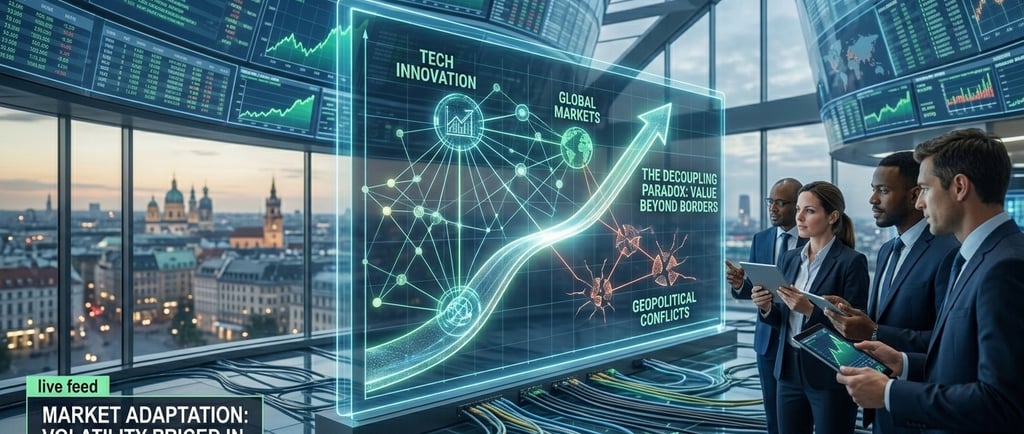
Despite global friction, markets are showing a 'resilience paradox,' decoupling from geopolitical noise and prioritizing technological growth
3/3/20263 min read

Executive Summary
For decades, the "Geopolitical Risk Premium" served as a foundational pillar of Wall Street analysis. Traditionally, regional skirmishes and border tensions acted as immediate catalysts for market retreats, driving capital toward safe-haven assets and triggering spikes in energy costs. However, in 2026, the script has fundamentally flipped. We are witnessing a "resilience paradox," where global equity markets demonstrate consistent growth and stability despite a backdrop of persistent friction. This report explores why markets have developed this "thick skin," how technological acceleration has decoupled corporate earnings from physical territory, and why institutional capital now perceives geopolitical noise as a background variable rather than a disruptive shock.
Introduction
The global economic landscape has entered a phase of permanent volatility. Yet, contrary to historical patterns, modern markets are no longer defined by fear. As of June 2026, we have transitioned from a reactive model—where every headline dictates the VIX—to a "new normal" where resilience is the default state. This shift is not accidental; it is the result of a deliberate, multi-year evolution in how supply chains are structured, how capital is allocated, and how technology is integrated into the core of every enterprise. The "Geopolitical Risk Premium," which once extracted a heavy toll on valuations during times of conflict, is being slowly overwritten by the productivity gains of the AI era.
The "New Normal" Factor: Modularity and Adaptability
Investors have largely moved past the paralyzing shocks of global instability. What was once classified as a catastrophic, portfolio-ending event is now analyzed as a manageable background variable. This resilience is rooted in the structural transformation of supply chains. Since the volatility of the early 2020s, global operations have shifted from fragile, "just-in-time" monoliths to modular, adaptive networks.
The Power of Redundancy: By diversifying sourcing across regions rather than relying on a single geographic node, companies have built the capacity to reconfigure in real-time.
Adaptability vs. Efficiency: Modern supply chains no longer prioritize raw efficiency at the cost of vulnerability; they prioritize adaptability. This shift means that a disruption in one part of the world no longer cascades through the entire system, allowing markets to look through the noise of regional disputes.
The Dominance of Tech and AI: The Decoupling Engine
The primary engine of current market growth is not geographic stability, but technological acceleration. AI integration has created a profound decoupling effect. When a major firm projects a $500 million increase in annual efficiency solely through autonomous workflows, a localized conflict thousands of miles away becomes significantly less relevant to their bottom line.
Earnings Over Optics: Corporate guidance is increasingly ignoring geopolitical "optics" in favor of concrete, technology-driven performance metrics. As long as quarterly earnings remain strong and AI-driven margin expansion holds, the market is choosing to prioritize bottom-line results over the transient news of international disputes.
Capital Reallocation: We are seeing a distinct trend where capital stays invested in high-growth, tech-intensive sectors rather than fleeing to traditional safe havens like gold or long-dated sovereign debt. Investors have realized that software and data—assets that can be moved and replicated globally in milliseconds—are the new, ultimate "safe assets" in a fragmented world.
The Pricing of Perpetual Volatility
Financial analysts have systematically integrated geopolitical tension into their long-term modeling. Conflict is no longer an "external shock"; it is a constant. Consequently, the "panic selling" cycles that characterized the early 21st century have been replaced by "buy-the-dip" institutional strategies. When a geopolitical headline triggers a temporary price correction, large-scale capital—armed with algorithmic precision—frequently enters the market to capture the value, confident that the underlying technological and productivity trends remain intact. We have effectively "priced in" the chaos, turning what was once a source of destabilization into a source of liquidity.
Conclusion: A Borderless Future
We are witnessing a fundamental shift in how value is perceived and preserved. In the modern economy, data, software, and energy independence are the true currencies. While the human cost of regional conflict remains high and tragic, the economic impact has been neutralized by a market that has learned to thrive in a state of permanent flux. We have reached a point where the physical location of a conflict is increasingly detached from the digital reality of the corporate entity.
"The market doesn't trade on the news of today; it trades on the perceived earnings of tomorrow. And tomorrow looks automated, efficient, and increasingly borderless."
Note: This report is current as of June 14, 2026.
Selected Bibliography
Morgan Stanley. Commodities Outlook 2026: Resilience Through Market Volatility. (April 2026).
World Economic Forum. Global Risks Report 2026: Navigating a Multipolar Order. (January 2026).
T. Rowe Price. Geopolitical Fragmentation and the Rise of the Risk Premium. (June 2026).
McKinsey & Company. Decoding Disruption: Reshaping Manufacturing Footprints in 2026. (January 2026).
Contact
Newsletter
contact@economicfinanceworldwide.com
Fone: +55 54 991220659
© 2026. All rights reserved. https://economicfinanceworldwide.com/privacy-policy