
The Ultimate Guide to Modern SEO: How to Build Authority and Sustainable Organic Traffic
Discover the strategic six-layer ecosystem that converts clicks into loyal customers and solidifies your domain authority on the web
STRUCTURAL
Salamon & Salamon
6/11/20264 min read
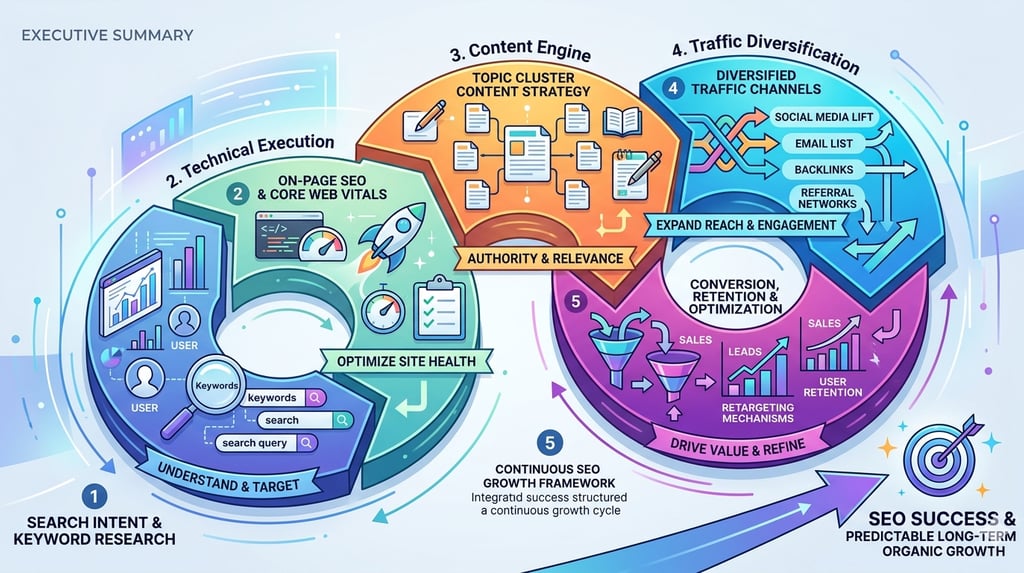
Executive Summary
This article presents a comprehensive, integrated blueprint for SEO success structured as a continuous growth cycle. Moving away from isolated tactics, it explores everything from the analytical foundation—rooted in search intent and keyword research—to technical execution (on-page and Core Web Vitals), topic-cluster content engines, traffic channel diversification, and ultimately, conversion, retention, and content optimization mechanisms. The objective is to provide a holistic framework for professionals seeking predictable, long-term organic growth.
Introduction
In today's digital landscape, reaching the top of search engine results pages (SERPs) is no longer a matter of cracking temporary "hacks" or stuffing keywords. Google's algorithm has evolved to heavily prioritize user experience, technical security, and, above all, the genuine authority of a domain.
For businesses and content creators—especially in highly competitive and regulated niches such as Finance and Wellness—SEO must be treated as a living ecosystem. If one gear fails, the entire attraction and conversion pipeline breaks down. This guide breaks down the definitive strategic map into execution blocks that transform cold traffic into a predictable, recurring growth asset.
The Strategic Foundation and Intent Alignment
Every successful SEO project begins long before the first paragraph is ever written. Keyword research is the bedrock of the entire workflow, but its real secret does not lie merely in mapping out high-volume terms. Success is found at the intersection of three crucial variables: search intent, search volume, and keyword difficulty.
Understanding search intent means deciphering what a user actually wants when they type a query into a search bar. Are they looking for a quick answer (informational), comparing products (commercial), or ready to buy (transactional)? Aligning this need with available search volume and the technical difficulty of ranking for that keyword allows brands to occupy underutilized spaces left by competitors, optimizing Return on Investment (ROI) from day one.
Technical Execution and Preparing the Ground
Once your target terms are defined, the next step is ensuring that both users and search engine bots can navigate your website flawlessly. This phase is split into two parallel fronts:
On-Page SEO: This refers to the direct optimization of visible and structural elements on the page. It involves crafting compelling titles, writing meta descriptions that drive clicks (CTR), correctly utilizing header hierarchies (H1, H2, H3) to organize text, and ensuring the intrinsic quality of the content.
Technical SEO: This is the engineering behind the screen. Here, the sole focus is on website infrastructure: page load speed and visual stability (Core Web Vitals), implementing canonical tags to prevent duplicate content, building SEO-friendly URL architectures, and ensuring the site is fully crawlable and indexable by search engine bots.
The Content Engine and Topical Authority
With your website's technical foundation in place, content production takes center stage. In mature markets, publishing random articles is no longer effective. The modern approach requires building Pillar Articles (Cornerstone Content) connected to Topic Clusters.
A pillar article is a comprehensive, deep-dive, evergreen guide on a macro topic. Surrounding it are cluster articles—smaller, hyper-specific satellite posts that answer niche user queries. These clusters connect back to the main pillar through strategic internal linking. This structure signals to Google that your site possesses deep topical authority on the subject, making it the ideal framework for industries like finance and wellness, where accuracy and trust are mandatory. This entire ecosystem must be driven by a strict, consistent editorial calendar.
Channel Diversification and Traffic Propulsion
High-quality content requires efficient distribution channels to accelerate its reach and relevance. A modern traffic strategy does not rely on a single source; instead, it leverages a coordinated multi-channel approach:
Traditional Organic Traffic: Continuous optimization focuses on core search engines like Google Search and Bing, alongside the Google Discover ecosystem, which is essential for capturing traffic spikes driven by current trends.
Visual and Search-Based Social Media: Platforms like Pinterest, YouTube, and Instagram function as alternative search engines, driving brand discovery and sending highly qualified traffic back to your blog.
High-Performance Link Building: This serves as the external validation of your authority. Through strategies like guest posting on partner portals and digital PR via platforms like HARO (Connectively), your site earns backlinks from high-authority domains, signaling to algorithms that your content is a trusted, industry-recommended resource.
Data-Driven Analysis, Monitoring, and Optimization
SEO stands out from traditional marketing due to its ability to be entirely measurable. The analytical heart of the process involves turning raw data into business decisions using two essential tools: Google Search Console (GSC) and Google Analytics 4 (GA4).
Constant monitoring allows you to track keyword rankings, identify which pages are gaining or losing traction, and analyze impressions against actual clicks (CTR). If a page generates high impressions but low clicks, the issue often lies in the title tag or meta description. If traffic arrives but leaves immediately, the page experience or content alignment may need work. Data eliminates guesswork and directs your efforts to where they will deliver the highest returns.
Conversion, Retention, and Asset Recycling
The ultimate goal of driving traffic is not to inflate vanity metrics, but to generate business results. The final mile of the ecosystem focuses on two critical components:
Conversion and Retention: Capturing visitor attention through strategic Calls to Action (CTAs), whether encouraging them to subscribe to a newsletter (email list), download a premium resource, or fill out a contact form. Retaining users and increasing time-on-page serve as highly positive signals to search engine algorithms.
Content Optimization and Refreshing: The work is not done once an article is published. Markets shift, and information becomes outdated. Reviewing, updating statistics, rewriting obsolete sections, and setting up redirections (when necessary) protects your rankings from decay and maximizes the historical authority that the URL has already accumulated.
Conclusion
Organic growth does not happen by accident; it is the result of a continuous, self-sustaining cycle. As demonstrated throughout this guide, every SEO action feeds into the next. Thorough keyword research supports flawless content execution, which is then amplified by diverse traffic channels and refined through data analysis.
By closing this loop with efficient conversion tactics and regularly recycling older content assets, your website builds a robust layer of domain authority that remains resilient against abrupt algorithm updates. Sustainable organic traffic is a cumulative asset: the effort you invest today will continue to generate leads, customers, and market relevance for months and years to come.
Bibliography & References
Enge, E., Spencer, S., Fishkin, R., & Stricchiola, J. (2018). The Art of SEO: Mastering Search Engine Optimization (3rd ed.). O'Reilly Media.
Google. Google Search Essentials (formerly Webmaster Guidelines). Google Search Central.
Moura, D. de. (2021). Real SEO: Search Optimization Strategies for Businesses. DVS Editora.
Patel, N. (2022). Modern SEO: How to Adapt Your Business to the New Algorithms. HarperCollins.
Sushan, J. T. (2024). Topical Authority and Content Clustering: The framework for modern organic growth. Journal of Digital Marketing Strategy, 8(2), 114-129.
Contact
Newsletter
contact@economicfinanceworldwide.com
Fone: +55 54 991220659
© 2026. All rights reserved. https://economicfinanceworldwide.com/privacy-policy