
Wall Street the brakes this week
Blog post description.
ECONOMYINVESTIMENT
5/20/20267 min read
Executive Summary
The week ending May 19, 2026, underscored the mounting friction between equity-market optimism and macroeconomic reality. While the S&P 500 maintains a 12% year-to-date gain, the convergence of 10-year Treasury yields breaching 4.60% and stubborn CPI prints (3.8% YoY) has triggered a necessary repricing of risk. Institutional capital is currently pivoting: fleeing high-beta technology and retail-exposed equities in favor of defensive positioning, while Bitcoin remains the sole digital asset attracting significant institutional inflows. We interpret the current volatility not as a structural break, but as a logical "gravity adjustment" in a restrictive interest-rate regime.
Introduction
Major stock indexes retreated across the board, Bitcoin slipped back below $80,000, and Ethereum continued its underperformance relative to the broader digital asset market. But is this a healthy correction, or the beginning of something more serious? Below, we break down the numbers, the forces driving the selloff, and what the rest of 2026 may look like for investors.
Stock markets this week: how bad was it?
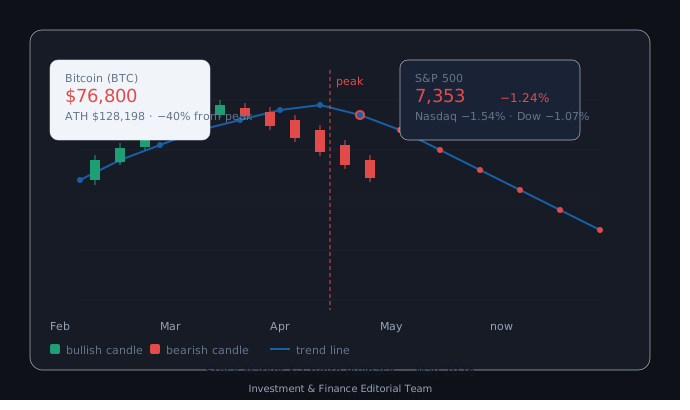
The week ending May 19, 2026, brought notable losses across all three major U.S. indexes. The S&P 500 slipped 0.07% to close at 7,353.61, while the Nasdaq Composite fell 0.51% to 26,090.73. Bucking the trend slightly, the Dow Jones Industrial Average managed a 0.32% gain, closing at 49,686.12. Even with the weekly volatility, the S&P 500 maintains a solid year-to-date return of 12%.
The real damage, however, was concentrated on Friday, May 15, when the selling accelerated sharply. On that day alone, the S&P 500 shed 1.24%, the Nasdaq tumbled 1.54%, and the Dow lost 537 points, a 1.07% drop. Despite this turbulence, it is important to remember that the S&P 500 hit fresh all-time highs just last week. This indicates a standard pullback within a broader uptrend rather than a structural collapse.
What caused the selloff?
Several macroeconomic and geopolitical pressures converged to drive investors out of risk assets this week.
Surging Treasury yields: The 10-year Treasury note climbed above 4.60%, reaching its highest level in over a year. Meanwhile, the 30-year yield surpassed 5.13%, hitting levels not seen in nearly a decade. These rising yields make bonds increasingly attractive relative to equities, placing heavy pressure on stock valuations.
Sticky inflation and hawkish Fed policy: April CPI rose 3.8% year-over-year, driven largely by surging energy costs tied to the ongoing Iran conflict. Reflecting these anxieties, the one-year inflation swap crossed above 4% for the first time since early 2023. Under the leadership of its new chair, Kevin Warsh, the Federal Reserve has maintained a distinctly hawkish tone, signaling that rate cuts remain a distant prospect.
Tech and semiconductor profit-taking: High-flying tech stocks bore the brunt of Friday's selloff. Nvidia dropped 3.6% to close at $227.27, Intel tumbled 6%, AMD slid 5.7%, and Micron Technology fell 6.6%. Seaport Research analyst Jay Goldberg noted that the semiconductor market is entering a choppy near-term phase, adding that while the secular AI trend remains a powerful force, many stocks have simply gotten ahead of their underlying fundamentals.
Geopolitical uncertainty: The U.S.-Iran conflict continues to push energy prices higher and disrupt global supply chains. At the same time, while the high-profile summit between Donald Trump and Chinese President Xi Jinping dominated headlines, it failed to deliver any major trade breakthroughs, leaving investors disappointed.
Retail sector weakness: Consumer spending is showing visible signs of cooling. The SPDR S&P Retail ETF dropped more than 6% this week, marking its fourth consecutive weekly decline and its worst weekly performance since October 2025. This drop follows April's retail sales (excluding autos), which grew by just 0.7%, a sharp slowdown from the 1.9% expansion seen in March.
This underlying weakness is broader than the headline indexes suggest. While the S&P 500 hit record highs last week, the median stock within the index is actually sitting 13% below its 52-week peak. Commenting on the market structure, Amundi’s CIO Vincent Mortier stated that a market correction is no longer just a risk, but an inevitability.
Crypto markets: Bitcoin holds $77K while Ethereum struggles
The digital asset market felt the macro squeeze, but performance diverged significantly between the two largest assets.
Bitcoin remains resilient but is clearly under pressure. The cryptocurrency is currently trading in the $76,800 to $77,000 range, representing roughly a 3% decline for the week and sitting about 40% below its all-time high of $128,198 achieved on October 6, 2025. Market sentiment has cooled to neutral, with the Crypto Fear & Greed Index hitting 49.
The $80,000 level aligns with Bitcoin's 21-week exponential moving average, serving as a structural floor. This support is further reinforced by five consecutive weeks of net-positive spot ETF inflows, including $153.87 million in net inflows for the week of May 1. However, with Q1 2026 CPI coming in at 4.5%—well above the Fed's 2% target—this support remains highly dependent on macro data.
Ethereum, on the other hand, continues to look like the weakest major asset. ETH is trading between $2,257 and $2,282, posting a weekly loss ranging from 0.5% to 4% depending on the exchange. The asset remains 54% below its all-time high of $4,953.73 from August 2025, and exchange reserves remain highly concentrated, with Binance holding 3.62 million ETH, or 24.6% of the total exchange supply.
Two structural factors explain this persistent weakness: a lack of fresh catalysts now that the Dencun upgrade is fully priced in, and a compressed staking yield advantage compared to high fixed-income yields. With the ETH/BTC ratio hitting a 10-month low this week, it is clear that capital is not leaving the crypto ecosystem entirely; rather, it is actively repositioning into Bitcoin.
This Bitcoin dominance is reflected in the broader market indicators. The Altcoin Season Index is hovering between 39 and 45 out of 100, firmly cementing the current period as "Bitcoin Season." Elsewhere, safe-haven demand has pushed Gold futures to $4,549 per ounce, while institutional cash levels among fund managers dropped from 4.3% to 3.9%, triggering a traditional contrarian sell signal.
What to expect through year-end 2026
Looking ahead, Wall Street analysts are eyeing three primary scenarios for the S&P 500. In the base case, the index targets 7,500 to 8,000, assuming Nvidia's upcoming earnings deliver and Treasury yields stabilize. A bearish breakdown could drag the index to the 6,500 to 6,800 range if the 30-year Treasury stays above 5% and the Iran conflict escalates. Conversely, Morgan Stanley's bullish target sits at 8,300, contingent on blowout AI earnings and a resolution to geopolitical tensions.
From a historical perspective, 2026 represents year two of the U.S. Presidential Cycle. Historically, this has been the riskiest year for markets since 1950, producing the cycle low 56% of the time. However, data from the IO Fund points out that these specific lows have also consistently served as the launching pads for multi-year uptrends.
In the crypto space, $80,000 remains the pivotal level for Bitcoin. A sustained weekly close above this mark would confirm a renewed bullish structure. Analysts note that if historical halving cycles hold true, Bitcoin may find its definitive bottom in October, making current near-term weakness an attractive accumulation window.
For Ethereum, the immediate $2,250 to $2,500 price triangle needs to resolve on high trading volume. A breakout above $2,500 would turn the outlook bullish, while a drop below $2,200 risks a swift retest of the $2,000 psychological floor. Long-term upside for ETH relies on accelerated AI-crypto convergence, Layer-2 scaling growth, and a broader expansion of spot ETH ETFs.
Meanwhile, the macro environment is unkind to broad altcoin speculation. Opportunities are highly selective and concentrated in real-world asset (RWA) tokenization, where projects like droppRWA have bucked the trend by securing $12.5 billion in mandates for tokenized real estate.
My take
We are witnessing a fascinating macro divergence: equities are trading near all-time highs while bond yields are screaming danger. At the same time, Bitcoin is holding the $77,000 line—40% below its October 2025 peak—and Ethereum is trading at less than half of its historical high as institutional capital heavily favors BTC. The narrative war between AI equity bulls and bond market bears will undoubtedly define the second half of 2026.
My view is that this correction is not quite over, but it is also not the death of the bull market. What we are experiencing is a logical asset repricing, not a structural regime change. Investors should maintain strict diversification across equities, fixed income, and select digital assets, using this pockets of weakness to accumulate high-quality positions. Keep a very close eye on Nvidia's earnings this Wednesday; it will likely be the single most important market catalyst of the month.
Conclusion
This week's market pullback was a natural reaction to rising Treasury yields, stubborn inflation data, tech profit-taking, geopolitical friction, and cooling retail numbers. Yet, context is everything: the S&P 500 remains up 12% for the year, and Bitcoin is holding firm above $76,000. The bull market is under stress, but it is far from broken. For disciplined investors with a clear strategy and a long-term horizon, pullbacks like this are exactly where opportunity is found.
Stay informed, stay disciplined, and remember that the market has survived 100% of the corrections in its history.
Selected Bibliography
Federal Reserve System. Consumer Price Index (CPI) Report: April 2026 Inflation Persistence and Energy Price Drivers. (May 2026).
Amundi Investment Institute. Market Outlook: Why Correction is the New Norm for 2026. (May 2026).
Goldman Sachs Global Investment Research. Semiconductor Cycle and AI Fundamentals: A Near-Term Reality Check. (May 2026).
Glassnode Insights. Bitcoin vs. Ethereum: Analyzing the Institutional Repositioning in Q2 2026. (May 2026).
J.P. Morgan Asset Management. The Presidential Cycle and Market Volatility: Historical Precedents for 2026. (April 2026).
U.S. Department of Commerce. Retail Sales and Consumer Spending Trends: April 2026 Data Analysis. (May 2026).
IO Fund. Market Cycles and Liquidity Analysis: Positioning for the Second Half of 2026. (May 2026).
Disclaimer: This article is for informational and educational purposes only and does not constitute financial advice. Cryptocurrency and equity investments involve significant risk. Always consult a qualified financial advisor before making investment decisions.
Contact
Newsletter
contact@economicfinanceworldwide.com
Fone: +55 54 991220659
© 2026. All rights reserved. https://economicfinanceworldwide.com/privacy-policy